The banks that financed the AI boom are quietly selling the risk. The real question is who ends up holding it. The answer, more than most people realise, is ordinary households.
What is actually happening
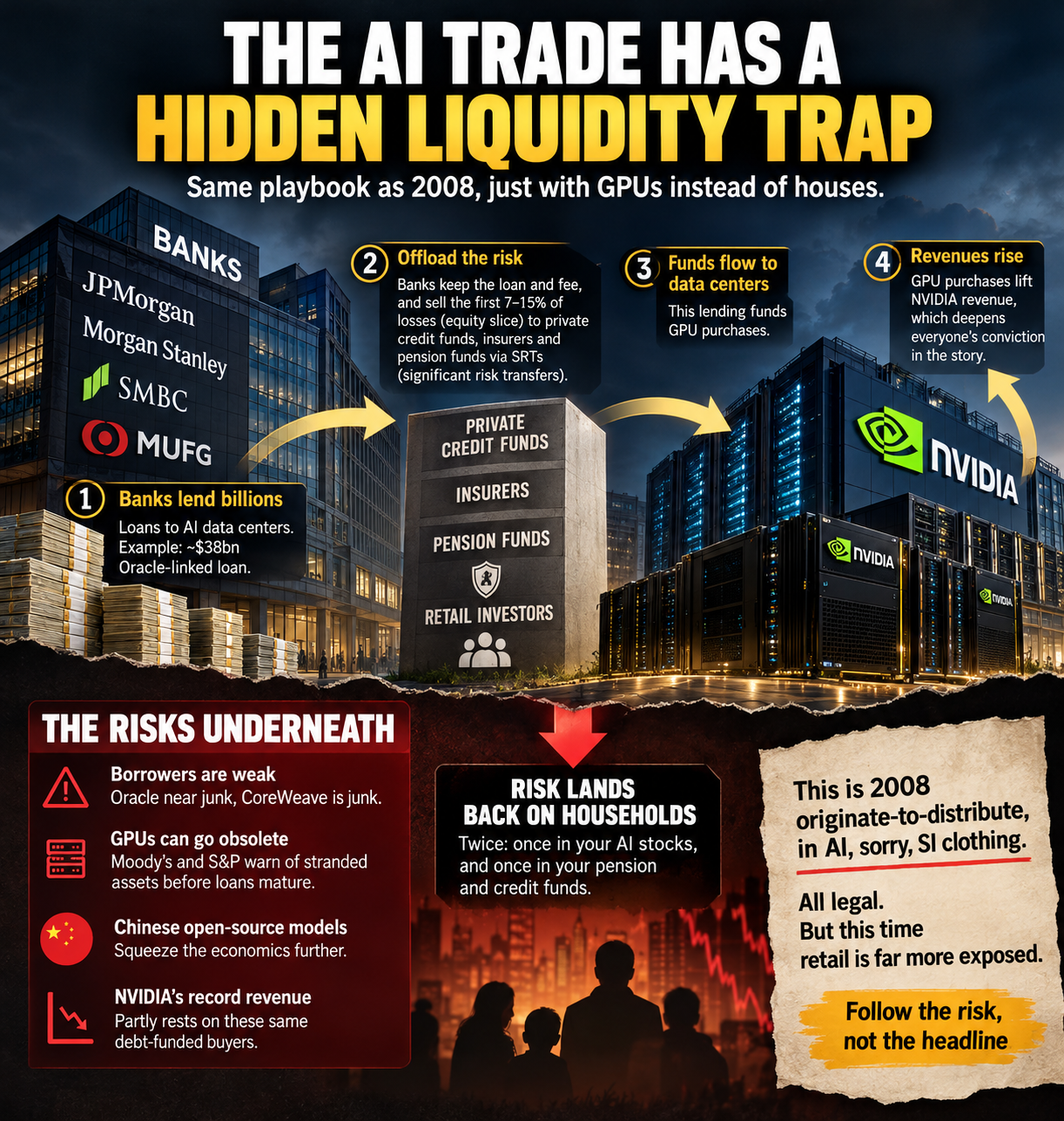
The big banks underwrote enormous loans to build AI data centers. Now they are selling off the riskiest parts of those loans, because their exposure to single borrowers like Oracle and CoreWeave is hitting internal limits.
According to reporting led by the Financial Times, lenders including JPMorgan, Morgan Stanley, SMBC and MUFG have been distributing this debt to outside investors. The clearest example is a roughly 38 billion dollar construction loan package for a data-center project in Texas and Wisconsin leased to Oracle. A group of banks spent months trying to place it, and some were willing to sell at a discount.
This is a model with a name. It is called originate-to-distribute, and it is the same approach that sat at the center of the 2008 financial crisis. A bank makes a loan it never intends to hold, then passes the risk on and keeps the fee.
Originate-to-hold versus originate-to-distribute
In the old, boring model, a bank made a loan and held it to maturity. If the borrower failed, the bank took the loss. That gave the bank every reason to lend carefully.
In originate-to-distribute, the bank makes the loan and then sells the risk to someone else. The fee is earned on day one. The danger sits somewhere else by the time anything goes wrong. The incentive to be careful weakens, because the bank is not the one left holding the loss.
How a significant risk transfer actually works
The main tool here is the significant risk transfer, or SRT.
The loan stays on the bank's books. What moves is the risk. The bank pays an outside investor a regular fee, and in return that investor agrees to absorb a slice of the losses if the loans go bad.
The slice that is sold is the first-loss layer, the part that gets wiped out first. In the United States, investors often take the first 12.5 percent of losses. In Europe the protected slice is often in the range of the first 7 percent. Market practice generally falls somewhere between 5 and 15 percent.
That small-sounding slice matters far more than its size suggests, because it carries most of the expected loss and most of the capital the regulator makes the bank hold. By selling roughly 10 to 12 percent of the risk, the bank frees up most of its capital, keeps the safer senior part, and still collects its fee.
The credit quality, in plain terms
Two things are weak here at the same time.
The borrowers are already shaky. Oracle sits near the bottom of investment grade, around two notches above junk, with a negative outlook. CoreWeave is rated junk. Many of the construction loans themselves are privately rated or not rated at all when they are made.
The slice being sold is the riskiest part of that already-shaky pool. It is, by design, the first money to be lost. So what changes hands is the junk end of a weak book.
Who ends up holding the risk
This is the part that should make retail investors sit up.
The buyers of these risk slices are mostly non-bank institutions: credit funds and hedge funds, which are the largest group, along with insurers and pension funds. Private credit itself, the asset class absorbing much of this, is increasingly funded not only by pensions and insurers but by retail investors, through non-traded and listed business development companies and interval funds.
So the household is exposed twice. Once directly, by owning the AI stocks on the strength of the revenue story. And once indirectly, because the risk the banks shed lands in pensions, insurance policies and retail credit funds, which is ultimately ordinary people's money.
There is a further twist. The Bank of England has warned that risk pushed outside the banking system can re-enter it through the banks' own lending to those same non-bank funds. In other words, the risk does not truly leave. It just becomes harder to see.
What the rating agencies are warning
The agencies are not quiet about this.
S&P has said the credit quality of the big technology spenders is gradually weakening, and that the financing is becoming more complex and less transparent.
Moody's has flagged that these companies carry around 1.2 trillion dollars in lease commitments, and that disclosures may not show the full picture. Its sharpest warning is the one that matters most for the loans: the hardware can become obsolete faster than the debt is repaid. If demand cools or tenants do not renew, the data centers risk becoming stranded assets with little alternative use, which can trigger sudden, steep downgrades.
The NVIDIA connection
The revenue story that draws retail in is tied to this same debt.
A meaningful part of NVIDIA's record revenue comes from selling chips to buyers who are funded by these loans. And NVIDIA does not just sell. It also backstops some of the demand. In its deal with CoreWeave, NVIDIA is the buyer of last resort for unused capacity through 2032. It has also made large commitments around OpenAI, including a reported guarantee tied to a major data-center lease, though the exact figures vary across reports.
So the loop runs like this. Banks lend and then offload the risk. NVIDIA sells chips and guarantees a slice of the demand. The revenue looks spectacular. Retail buys the stock on that revenue and sits last in line if anything breaks.
The pressure from cheap Chinese models
There is one more force that makes the debt fragile: cheap, open-source Chinese AI models.
When DeepSeek showed in early 2025 that a capable model could be trained far more cheaply, NVIDIA fell sharply in a single day on fears that demand for expensive chips would collapse. The bull answer, argued by NVIDIA itself, is that cheaper models actually increase total compute demand, and that compute is now the binding constraint.
But there is a bearish reading that matters for the loans. If open-source models from labs like DeepSeek, Qwen and Kimi keep commoditising AI and compressing the prices and returns that justify these giant data centers, the revenue assumptions underpinning all that debt weaken. That feeds straight into the stranded-asset risk the rating agencies describe. Chinese domestic chips are not yet good enough to replace NVIDIA for frontier work, but they are improving, which is a second, slower threat to its pricing power.
Why this rhymes with 2008, and why it is different
In 2008, banks made risky home loans, sliced them up, and sold the risk onward until almost no one could see where it sat. When the underlying loans failed, the losses surfaced in places people did not expect.
This time the underlying asset is not houses. It is AI data centers and the chips inside them. The structure is the same: make the loan, sell the risk, earn the fee.
The difference is not comforting. Retail exposure to the center of this boom, through concentrated holdings in a handful of AI names and through growing access to private credit, is far larger than it was in the last cycle.
The honest caveats
A few things should be said plainly.
None of this is illegal. Risk transfer is a normal, legitimate tool. That is exactly why it deserves attention rather than outrage.
The deals are private, so exact slice sizes and buyers are not public. The figures here come from market-practice ranges and from reporting by the FT, the IMF, the FSB and the Bank of England, not from individual term sheets.
And a lot of the risk still sits with institutions rather than directly with small investors. But institutional money is, in the end, household money, through pensions and insurance.
What to watch
- Whether more of these loans are sold at a discount, which would signal buyers are getting nervous.
- Rating actions on Oracle, CoreWeave and similar borrowers.
- GPU rental prices and tenant renewals, the early tell on the stranded-asset risk.
- How fast Chinese open-source models and domestic chips erode NVIDIA's pricing power.
- The growth of retail access to private credit, through BDCs and interval funds.
Bottom line
The smartest money in the room is being paid to reduce its exposure to the AI buildout, while retail is being drawn in to increase its own, on a story of record revenue and trillion-dollar valuations. The banks have found a legal, quiet way to pass the risk on. The people most likely to be left holding it, directly through their stocks and indirectly through their pensions and credit funds, are the ones watching the headline numbers and assuming someone else has checked the risk.
Follow the risk, not the headline.
Educational purposes only, not investment advice.
Sources: Financial Times reporting on banks distributing AI data-center debt, including the roughly 38 billion dollar Oracle-leased project; IMF and industry primers on significant risk transfer structures and loss tranches; Financial Stability Board report on private credit and its investor base; Bank of England financial stability warnings on risk transfer and non-bank exposure; S&P and Moody's commentary on hyperscaler credit quality, lease commitments and GPU obsolescence; reporting on NVIDIA's CoreWeave and OpenAI backstop arrangements; and reporting on Chinese open-source AI models and their effect on compute demand.