The comforting reading is that China's move forces India to become self-reliant. The honest reading is that India was never close to self-reliant in solar, and China has just made the missing part harder to get.
What China proposed
On 16 October, China's Ministry of Commerce proposed adding 12 photovoltaic technologies to its export-control list. It is part of a wider revision that also covers AI and biotechnology. Public comments close on 15 November.
- Banned: technology for some thin wafers, perovskite and tandem solar cells, and large-scale fluidized-bed polysilicon production.
- Licence needed: advanced cell technology, including TOPCon, HJT and back-contact (XBC).
- Not covered: finished solar panels.
Until the list is formally updated, exporters must register certain overseas technology transfers. Reuters also reports that Beijing has already been curbing exports of solar-manufacturing technology to India.
India built the easy half
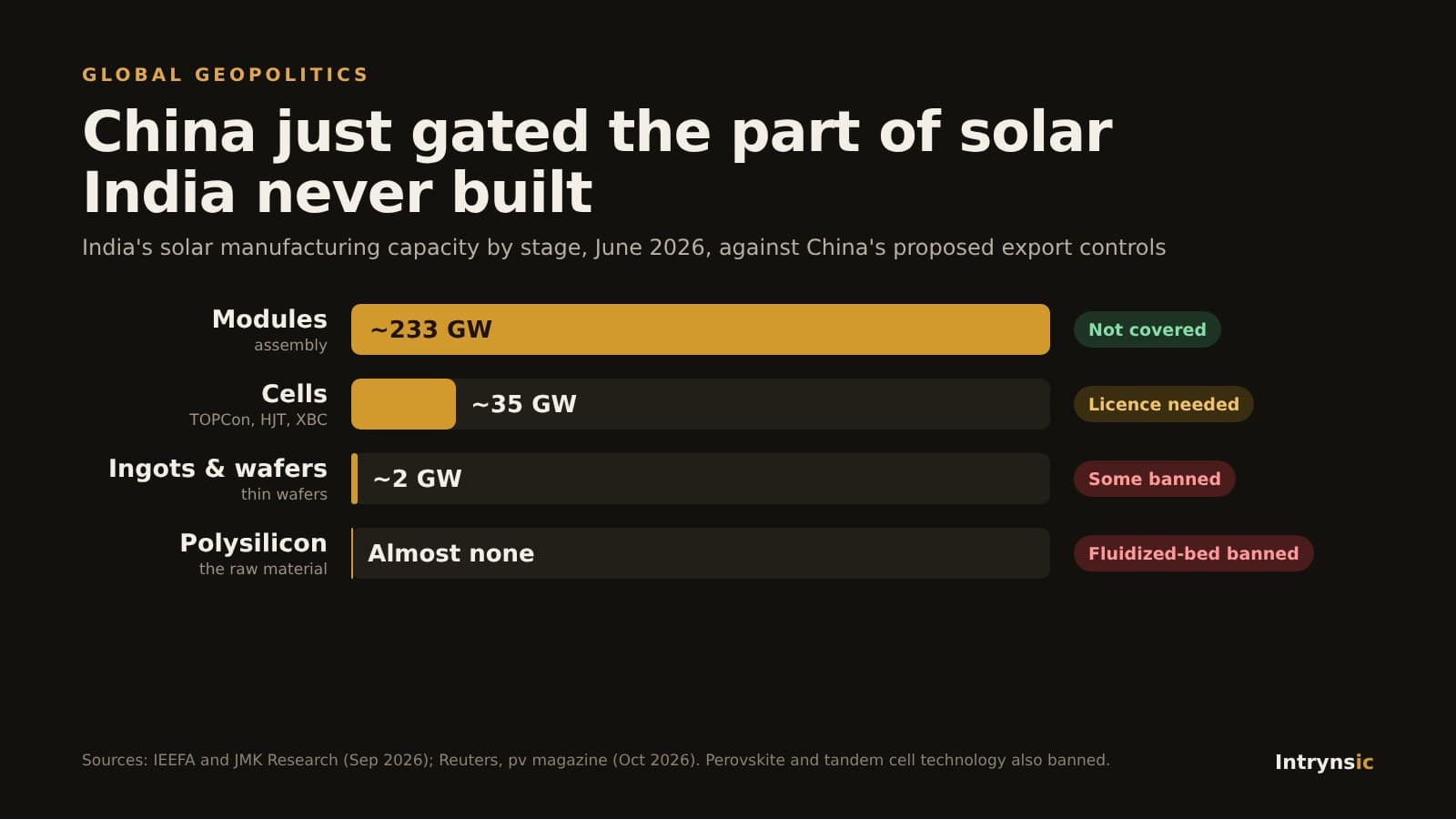
A solar panel is made in four steps: polysilicon, then ingots and wafers, then cells, then modules. India's capacity at each step, as of June 2026, according to IEEFA and JMK Research:
| Step | India's capacity | China's proposed control |
|---|---|---|
| Modules | ~233 GW | Not covered |
| Cells | ~35 GW | Licence needed (TOPCon, HJT, XBC) |
| Ingots and wafers | ~2 GW | Some thin-wafer technology banned |
| Polysilicon | Almost none | Fluidized-bed technology banned |
Module capacity is about seven times cell capacity and about 116 times ingot and wafer capacity. Of the ~35 GW of cells, nearly 33 GW is used in-house by integrated makers, leaving about 2 GW for everyone else.
So what India mostly did was import cells, largely from China, and assemble them into panels. That was the sensible thing to do, because module assembly is the cheapest and quickest step to set up. Polysilicon, ingots and wafers are the opposite: they need far more capital per gigawatt, years to build, and process know-how that sits mostly in China.
Why this is negative, not a blessing
The argument for "good news" is that a ban pushes India to build its own supply chain. It doesn't cut the dependence. It only makes the gap harder and costlier to close.
- The know-how is the bottleneck. India's upstream plans leaned on Chinese equipment, engineers and process recipes. A licence regime adds delay and uncertainty to every new cell line, and the bans shut the door on some wafer and polysilicon routes altogether.
- The money is the other bottleneck. Upstream plants are capital-intensive and only pay off at scale. Government support has been modest compared with the size of the gap, and polysilicon expansion was not expected before 2030 even before this.
- The demand clock keeps running. Since 1 June 2026, projects under ALMM List-II must use domestically made cells. With cell capacity a fraction of module capacity, any slowdown in new cell lines squeezes developers and the target of 500 GW of non-fossil capacity by 2030.
Winners and losers
Not every company is hit equally.
- Slightly better placed: makers with non-Chinese partners. Websol Energy's ingot and wafer plans are with Linton Crystal Technologies, a US company based in Rochester, New York, which reduces its upstream exposure to China.
- The open question: Websol is also converting one of its 600 MW mono-PERC lines to TOPCon, at about ₹270 crore, due by March 2027, taking cell capacity from 1.2 GW to 1.35 GW. Reports don't say whose equipment it uses. If the process relies on Chinese tools or know-how, a licence requirement could slow it.
- Most exposed: pure module assemblers that depend on imported cells, and anyone whose cell or wafer roadmap was built on Chinese technology transfer.
Bottom line
China has not touched what India makes. It has gated what India needs to make next. Mildly positive for a handful of companies with non-Chinese partners, negative for India's solar build-out as a whole.
Educational purposes only, not investment advice. DYOR.
Sources: Reuters via Business Recorder (18 Oct 2026); pv magazine (16 Oct 2026); IEEFA and JMK Research (1 Sep 2026); Down to Earth; PV Tech on Websol; Mercom on ALMM List-II.
Follow along: @tyrovirtuoso on X