Closing Auction Session: Average se Auction tak.
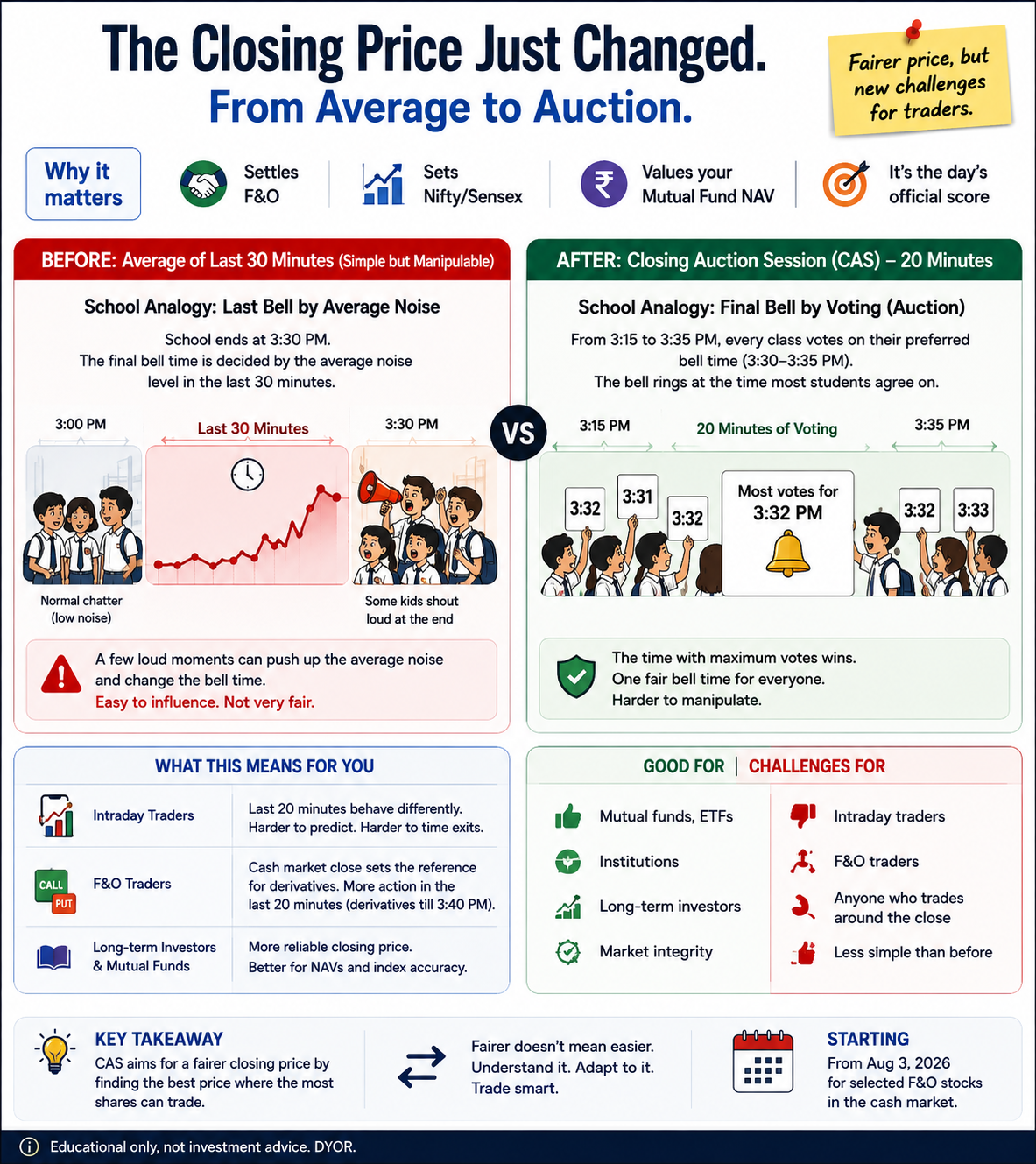
SEBI has changed how the closing price is decided for selected (F&O) stocks, effective Aug 3, 2026. It sounds technical, so let us explain it like a school.
First, why the closing price even matters
The closing price is the day's official score for a stock. It settles futures and options, sets index levels (Nifty / Sensex), and values your mutual fund NAV. Because so much money references it, it has to be clean and hard to rig.
BEFORE: the average-noise bell
Imagine school ends at 3:30 PM, and the final bell time is decided by the average noise in the last 30 minutes. Most students are quiet, but a few start shouting loudly just before the bell, and that noise pushes up the average.
That is roughly the flaw in the old method (a VWAP - the volume-weighted average of the last 30 minutes): a few large trades near the end could tilt the closing price. Easy to influence, not very fair.
NOW: CAS, the voting bell
Now imagine that in the final stretch (roughly 3:15 to 3:30), every class votes on when the bell should ring - 3:31? 3:32? 3:33? The time with the most votes wins.
That is the Closing Auction Session. Buyers and sellers put in their orders, and the exchange finds the single price where the maximum number of shares can actually trade. That becomes the closing price - one fair price for everyone, hard to move with a single order.
So, is it better?
Potentially fairer, but not necessarily easier.
The good: harder to manipulate the close, better price discovery for funds and long-term investors, and it brings India in line with the global norm. NYSE, LSE, ASX and most developed markets already run closing auctions - India was one of the last big markets still using a VWAP close.
The catch: the last stretch of the day now behaves differently. Intraday traders have a new learning curve, and F&O traders need to understand how the cash-market close feeds their settlement. Early on, the transition itself can create real short-term volatility and confusion - something already visible in Bank Nifty in the first days.
The Hong Kong lesson (and an important nuance)
Hong Kong is the cautionary tale here, but the lesson is not "closing auctions don't work" - it is that the auction's design and safeguards matter enormously.
HKEX introduced a 10-minute closing auction in May 2008, with a fixed close at 4:10 PM. Then came March 9, 2009. HSBC's indicative closing price was around HK$37, and in the final seconds very large sell orders hit the system, collapsing the indicative price to about HK$33 - roughly an 11% fall in seconds. The very next day, HSBC opened around HK$37.25, essentially reversing the move.
Was it manipulation? This is where you have to be careful. Hong Kong's regulator (the SFC) investigated and did not conclude it was manipulation, though it found the sheer size of the orders was likely to create undue volatility in the closing price. So the accurate framing is not "a trader crashed HSBC 10%", but "a massive last-second sell order pushed HSBC's indicative close down ~11% in seconds, exposing a flaw in the auction's design."
It was not only HSBC either - several stocks saw wild closing-auction swings, raising fears the fixed-time mechanism could be exploited by large orders near the known closing second. So HKEX suspended the auction from March 23, 2009 and reverted to its old method.
The interesting part: Hong Kong did not abandon closing auctions - it redesigned them. When HKEX brought the auction back in 2016, it added the safeguards that had been missing: a randomised closing time (so nobody knows the exact final second), a tight ±5% price limit around a reference price, and a better reference-price mechanism. That version has worked.
My read
The old system was simple. The new one may be harder to game, but retail traders now have to learn new rules, and the first weeks can be bumpy (as Bank Nifty is already showing).
Fairer doesn't necessarily mean easier. The real story of India's CAS isn't just "VWAP to auction" - it's whether the safeguards (price bands, a randomised close) are strong enough to avoid Hong Kong's 2009 mistake. Get the design right and it genuinely improves price discovery. Get it wrong and an auction can be gamed worse than the average it replaced.
Understand it, adapt to it, trade smart.
Educational only, not investment advice. DYOR.
Sources: Hong Kong closing-auction episode and 2016 redesign - Journal of Financial Markets study (doi.org/10.1016/j.finmar.2021.100700); SFC investigation statement (ref 13PR51); HKEX suspension notice (Mar 2009). India CAS framework - SEBI / NSE-BSE circulars.
Follow along: @tyrovirtuoso on X