Ghar ka paisa, ghar ka sahara - the quiet rewiring of the Indian market.
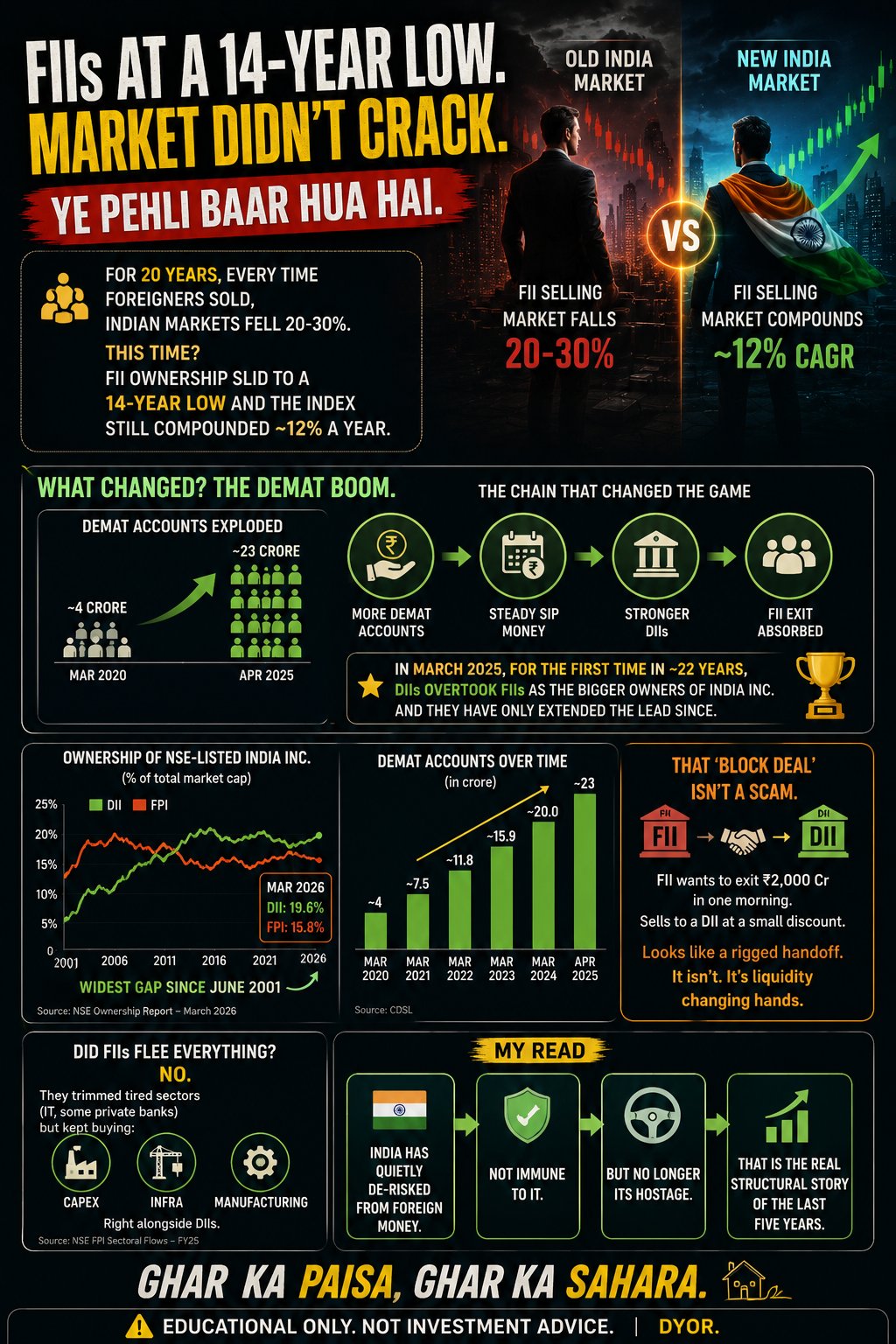
FIIs are at a 14-year low in India. And yet the market did not break. Something structural has changed. Here is the story - educational only, not investment advice.
The old playbook is broken
For years, the simple India-market playbook was: FII buying pushes the market up, FII selling pulls it down. Every global shock - a US Fed rate hike, a war, a tariff announcement - would send foreigners out and Indian stocks down 20 to 30%. Not anymore. This time foreign ownership slid to a 14-year low and the index still compounded about 12% a year.
What changed: the demat boom
Demat accounts exploded from about 4 crore in March 2020 to about 23 crore today. That is crores of new savers pushing money into equities every month, much of it through SIPs. That steady flow is exactly what let DIIs keep buying - and step by step, they absorbed the very shares FIIs were selling.
The chain is simple: more demat accounts to steady SIP money to stronger DIIs to FII exit absorbed.
The crossover: first time in 22 years
In March 2025, for the first time in about 22 years, DIIs overtook FIIs as the bigger owners of NSE-listed India Inc. And they have only extended the lead since. By early 2026, DII ownership was about 19.6% versus FPI at about 15.8% - the widest gap since 2001.
That scary "block deal" is not a scam
When a foreign fund wants to exit ₹2,000 crore in a single morning, it sells the whole lot to a domestic fund at a small discount. On a retail screen it looks like a rigged, secret handoff. It is not - it is simply liquidity changing hands. One sells, the other absorbs.
Did FIIs flee everything? No.
It is easy to picture FIIs as total exiters. They were not. They trimmed tired sectors (IT, some private banks) and the new-age loss-makers, but kept buying capital goods, infrastructure and manufacturing right alongside DIIs.
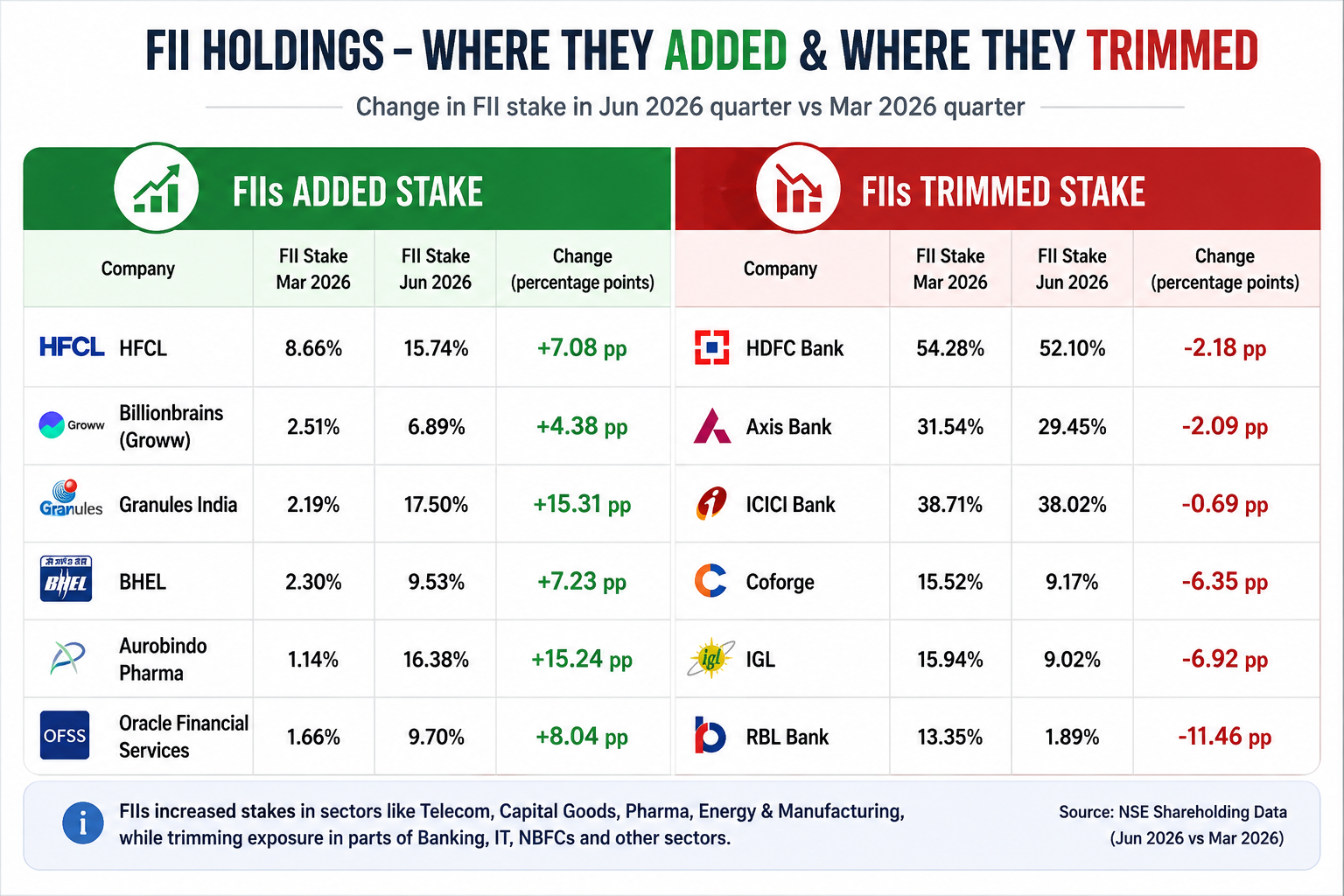
One honest nuance worth adding: in pure share-count terms, FIIs did not dump wholesale. Across the period their absolute holding stayed roughly flat - their percentage fell largely because the market grew and DIIs bought most of the new supply. So the value-based "FII decline" overstates how many shares foreigners actually sold. The genuine, large move was DIIs accumulating, funded by that wall of domestic savings.
The bigger point
India has not become immune to foreign money - it has become less dependent on it. Foreign capital can still move India, but it no longer owns the steering wheel. The real story of the last five years is not just Nifty returns - it is the deepening of domestic capital: 4 crore demat accounts to 23 crore, SIPs to DIIs to a permanent domestic base.
Ghar ka paisa, ghar ka sahara.
Educational only, not investment advice. DYOR.
The original thread: my post on X Follow along: @tyrovirtuoso on X