Gaja Capital IPO: upar se simple, andar se AIF.
Gaja Capital is India's first standalone listed private-equity / alternative-fund manager. On the face of it the numbers look clean.
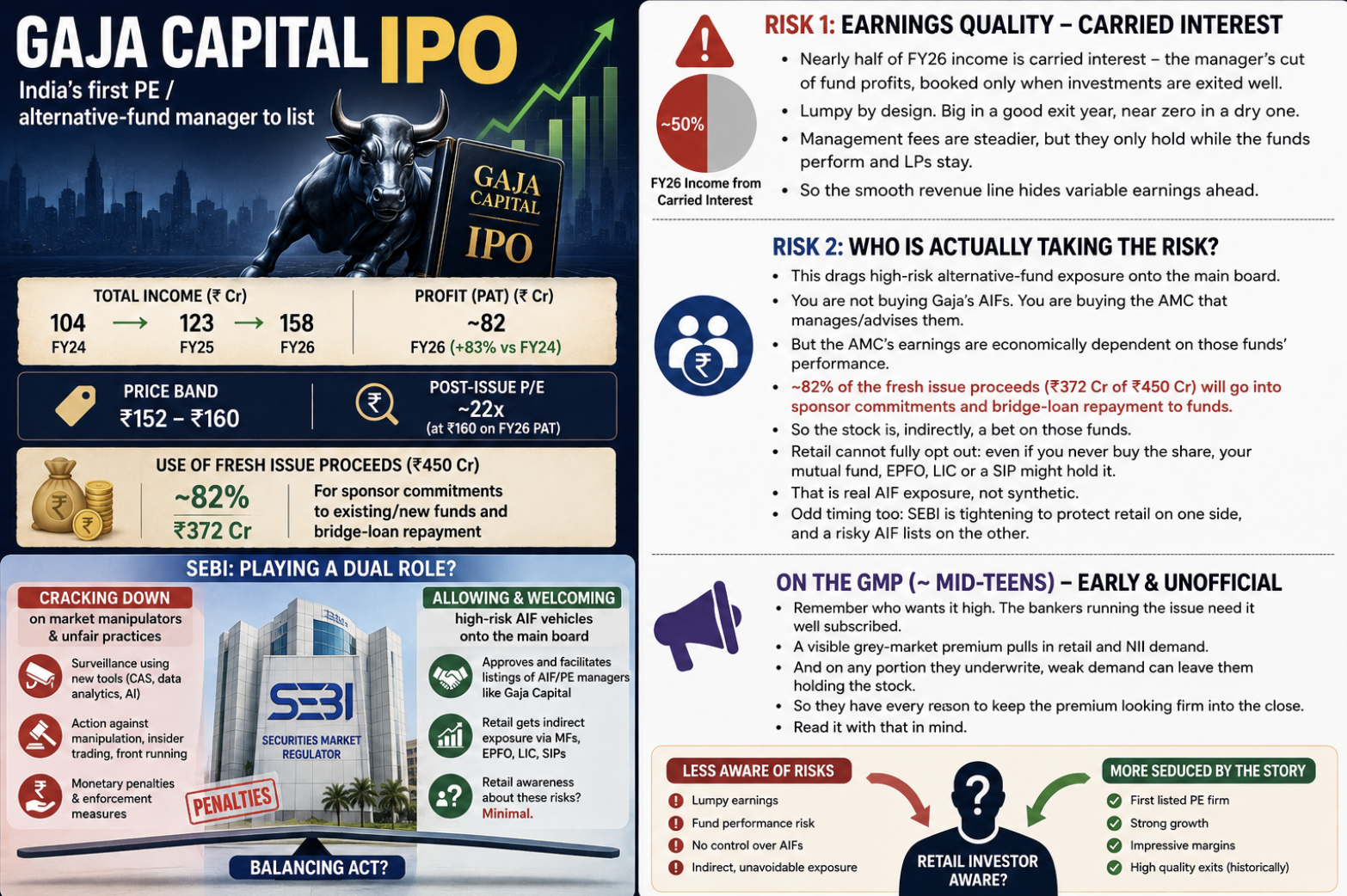
Total income : ₹104cr to ₹123cr to ₹158cr across FY24 to FY26. FY26 profit (PAT) : ₹82cr, up about 83% versus FY24. Price band ₹152-160, which at ₹160 is roughly 22x FY26 earnings. Reasonable, not cheap.
Looks straightforward. But here is what bothers me.
The IPO in brief
The issue (Gaja Alternative Asset Management Ltd, the Gaja Capital brand) is a ₹550 crore book-build : ₹450 crore fresh issue plus a ₹100 crore offer for sale. It opened on Aug 19 and closes Aug 21, 2026, with a lot of 93 shares, allotment around Aug 24, and listing near Aug 26 on NSE and BSE. Marquee names (HDFC Life, SBI Life) came in through a pre-IPO round. So far so normal. The interesting part is underneath.
Risk 1 : earnings quality
A meaningful chunk of the earnings comes from carried interest - the manager's share of the profits its funds make for their investors, typically around a fifth of the gains, and only above a minimum hurdle return. The catch is that carry is booked only when investments are exited well. It depends on two things at once : the fund actually making a profit, and that profit being realised through an exit.
That makes it inherently lumpy. A great exit year means big carry. A dry year means little or none. Nearly half of FY26 income was carried interest, so a chunk of that ₹82cr PAT is performance-linked, not recurring.
Management fees are the steadier leg - they are tied to assets under management. But even those only hold while the funds perform and the investors (LPs) stay; if performance slips, fundraising dries up, AUM shrinks, and the fee base with it. So a smooth-looking P&L can still contain highly variable economics underneath.
Risk 2 : what are you actually buying?
This is the bigger one. You are not buying Gaja's funds. You are buying the AMC - the manager - that runs and advises them. But the AMC's earnings are economically dependent on those funds' performance, so the separation is thinner than it looks.
And follow the money. About 82% of the fresh-issue proceeds (roughly ₹372cr of the ₹450cr) are earmarked for sponsor commitments to existing and new funds, plus bridge-loan repayment. This is not a factory where IPO capital buys machines and capacity. The capital is being used to strengthen the fund platform and its ability to seed funds. Not necessarily bad - but it means the stock is, indirectly, a bet on Gaja's ability to keep raising funds, deploying capital and generating exits.
Now the part that sits least well with me. This drags genuinely high-risk alternative-fund exposure onto the main board. Retail cannot fully opt out of it : even if you never buy the share yourself, your mutual fund, your EPFO, your LIC policy or a passive SIP might hold it. That is real alternative-investment exposure, not synthetic. And the timing is odd - on one side SEBI is tightening the screws to protect retail (the new closing-auction session, surveillance, crackdowns on manipulation), and on the other, a risky AIF platform lists on the main board where awareness of these risks is minimal. Whose job it is to make sure investors understand what they are carrying is an open question.
On the GMP
The grey-market premium is in the mid-teens, and it is early and unofficial. Remember who wants it high. The bankers running the issue need it well subscribed. A visible grey-market premium pulls in retail and NII demand, and on any portion they underwrite, weak demand can leave them holding the stock. So they have every reason to keep the premium looking firm into the close. Read it with that in mind.
My read
At ~22x FY26 earnings, I do not think Gaja is cheap. The business is genuinely attractive if you understand it - the margins are impressive and the historical fund performance is strong. But the earnings are not as predictable as a normal asset-light business, because a large slice of them rides on lumpy, exit-dependent carry.
Investable? Yes. Low-risk? Definitely not. That is the distinction I would keep in mind - especially if your exposure is coming indirectly through a fund you did not pick.
Educational only, not investment advice. DYOR.
Sources: Gaja Alternative Asset Management RHP / IPO disclosures; exchange and registrar IPO data (JM Financial, MUFG Intime); brokerage and IPO-tracker analyses on valuation, use of proceeds and GMP (Aug 2026).
Follow along: @tyrovirtuoso on X