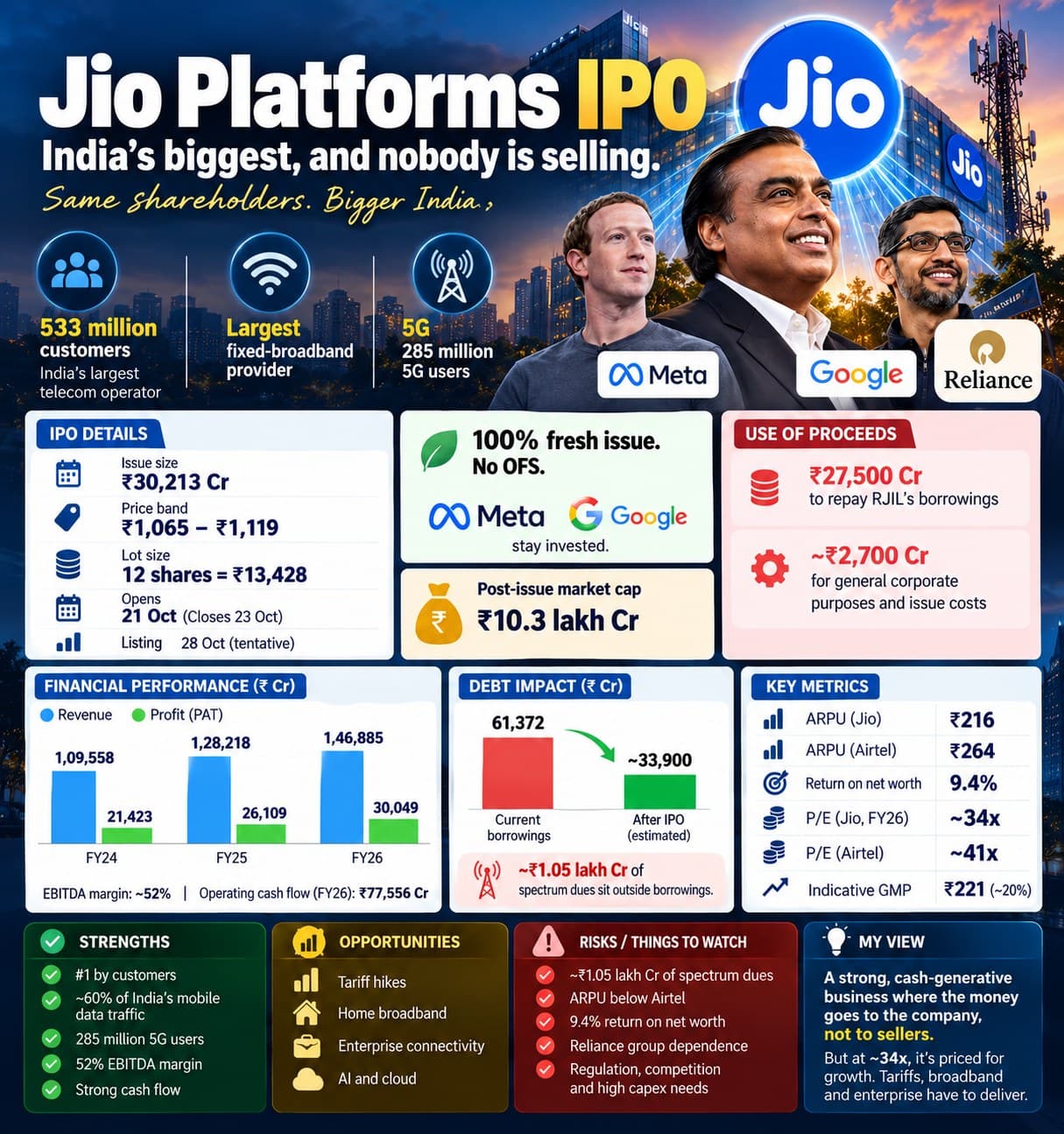
Most mega IPOs are an exit for someone. This one is not. Every share on offer is new, and the money goes to the company. The question is only the price.
The issue
Jio Platforms opens on Wednesday, 21 October 2026 and closes on Friday, 23 October, at a price band of ₹1,065 to ₹1,119. The lot is 12 shares, ₹13,428 at the top of the band. Listing is expected on 28 October on NSE and BSE.
The issue is ₹30,213 crore, and all of it is a fresh issue. There is no offer for sale (OFS), so no existing shareholder is selling. Reliance's stake is diluted from 66.43% to 64.48% because new shares are issued. Meta and Google keep their shares too, though their percentages shrink a little.
Post-issue market cap at ₹1,119 is about ₹10.3 lakh crore. The split is the standard one for a profitable company: 50% for institutions, 15% for non-institutional investors and 35% for retail. Reliance shareholders and employees have their own quotas.
What the company does
Jio Platforms is the parent of Reliance Jio, India's largest telecom operator, with 533 million customers across mobile and fixed broadband as of June 2026. It is also India's largest fixed-broadband provider, and it says it carries about 60% of India's mobile data traffic, with 285 million 5G users. Beyond connectivity, it sells enterprise services, cloud and AI solutions.
Its main subsidiary, Reliance Jio Infocomm (RJIL), brings in about 88% of revenue and about 95% of EBITDA.
Well cooked or rushed?
Well cooked. Profit has grown every year and margins have been steady. There is no sudden jump just before the IPO.
| ₹ crore | FY24 | FY25 | FY26 | Q1 FY27 |
|---|---|---|---|---|
| Revenue from operations | 1,09,558 | 1,28,218 | 1,46,885 | 39,173 |
| EBITDA | 54,959 | 64,170 | 76,255 | 20,865 |
| EBITDA margin | 50.2% | 50.1% | 51.9% | 53.3% |
| PAT (to shareholders) | 21,423 | 26,109 | 30,049 | 7,764 |
| Operating cash flow | 68,156 | 77,556 | 23,446 | |
| Borrowings | 54,349 | 73,060 | 70,781 | 61,372 |
Operating cash flow, the cash actually collected from running the business, was ₹77,556 crore in FY26, a little above EBITDA. Telecom eats cash, though: about ₹43,600 crore went into investing activities in FY26, mostly the network.
Where the money goes
- ₹27,500 crore repays borrowings of RJIL.
- The remaining ₹2,700 crore or so goes to general corporate purposes and issue costs.
After the repayment, borrowings could fall from ₹61,372 crore to about ₹33,900 crore, assuming nothing else changes. But reported borrowings are not the whole story. Jio also owes about ₹1.05 lakh crore in deferred spectrum payments, money owed to the government for airwaves already bought and paid in instalments. That sits outside borrowings, but it behaves like debt.
Valuation vs Airtel
| Jio Platforms | Bharti Airtel | |
|---|---|---|
| P/E (FY26) | ~34x | ~41x |
| ARPU (₹ per month, June quarter) | 216 | 264 |
| Return on net worth (FY26) | 9.4% | 20.3% |
Jio looks cheaper than Airtel on earnings. Airtel, though, earns about ₹48 more per user every month and makes twice the return on its equity. Jio's 9.4% return on net worth is held down partly by its very large equity base.
SWOT
- Strengths: #1 by customers, about 60% of mobile data traffic, 285 million 5G users, a 52% EBITDA margin, strong cash flow.
- Weaknesses: ARPU below Airtel, modest return on net worth, heavy dependence on one subsidiary, large spectrum dues.
- Opportunities: tariff hikes, home broadband, enterprise connectivity, AI and cloud.
- Threats: regulation and levies, competition, and fresh capex every technology cycle.
Flags
- Spectrum dues of about ₹1.05 lakh crore sit outside reported borrowings.
- Reliance group dependence, for example for prepaid distribution.
- Promoter control: Reliance stays firmly in charge, so minority shareholders have little say.
- Workforce mix: 63,795 contract staff against 27,932 employees as of June 2026.
Demand
The indicative grey market premium (GMP) is about ₹221, around 20% above the top of the band, at the time of writing. GMP is a sentiment signal, not a valuation, and it moves daily.
Verdict
A strong, cash-generative business where the money goes to the company, not to sellers. But at about 34 times earnings it is priced for growth. Tariffs, broadband and enterprise have to deliver, and the spectrum dues have to be paid.
Educational purposes only, not investment advice. DYOR.
Sources: Jio Platforms Limited red herring prospectus (SEBI, 15 October 2026); Chittorgarh IPO page; TaxGuru RHP summary; Angel One; Investorgain (GMP, peer P/E), 16 October 2026; Kotak Neo (ARPU, spectrum dues); The Strategy Story.
Follow along: @tyrovirtuoso on X