Paneer bhi premium, IPO bhi premium - Milky Mist ka funda.
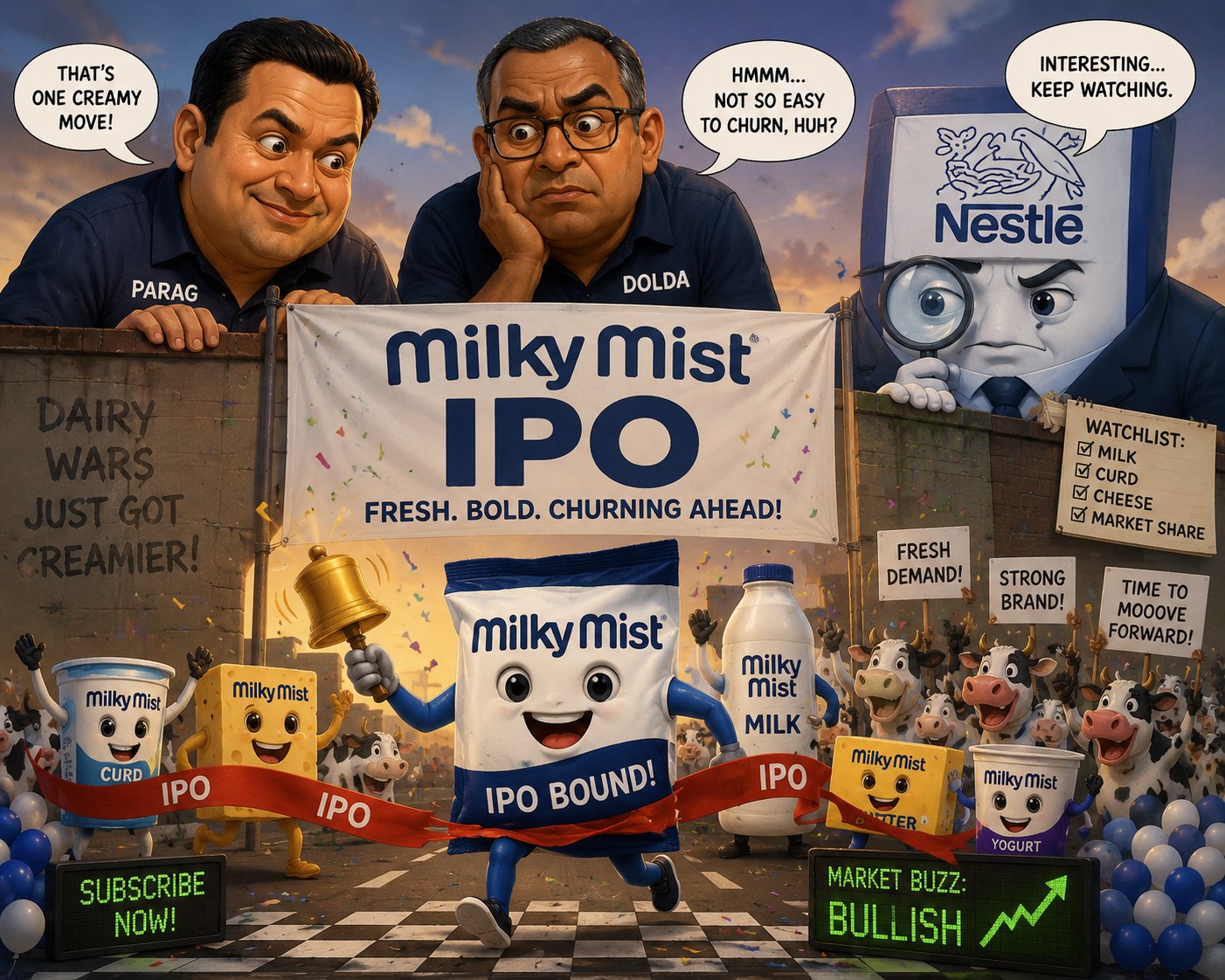
Milky Mist's ₹1,553 crore IPO just closed - subscribed about 59 times, listing on August 18. Here is my honest read: a genuinely differentiated, high-margin dairy business, but one carrying more debt than its peers and priced at a clear premium. Quality, at a demanding price.
Not investment advice - just how I see it.
What I genuinely like
1. It earned the right to list. Milky Mist went public after three straight years of real, growing profits - not the increasingly common dash to the market by a barely-profitable company rushing to list on the back of a single, semi-cooked profitable quarter. Patience like that tells you something about how the business is run.
2. It controls the whole chain. Procurement (~75,000 farmers), processing, and distribution are all in-house. It owns every lever from the farm to the fridge.
But - and this is the honest part - that control isn't its real edge. Dodla and Parag are just as integrated. In fact Dodla runs 16 processing plants and Parag 3, against Milky Mist's single plant in Perundurai, Tamil Nadu; both have pan-India distribution and larger farmer networks. On integration alone, Milky Mist is actually the smaller, more concentrated player.
The real differentiator: what it chooses to sell
Here is where Milky Mist genuinely stands apart. Dodla and Parag lead with liquid milk (and cheese at best) - a largely commoditised, thin-margin business. Milky Mist deliberately avoids commoditised milk and focuses on premium value-added products: paneer, cheese and Greek yoghurt.
That single choice is why its profitability looks nothing like its peers':
| Milky Mist | Dodla | Parag | |
|---|---|---|---|
| Product focus | Value-added only (paneer, cheese, yoghurt) | Liquid-milk led | Milk + cheese |
| Plants | 1 (Perundurai, TN) | 16 (South India + Africa) | 3 (Maharashtra, AP, Haryana) |
| EBITDA margin (FY26) | ~14% | ~7.5% | ~8.1% |
It prices its products at a premium, sells a premium mix, and earns premium margins. That is the bull case in one line.
The catch: the balance sheet is heavy
Most of the IPO money isn't going into exciting growth - it is going to repay debt and fund capex. The company carries roughly ₹1,672 crore of debt, and the raise should retire about 30% of it. That is a real positive.
But even after that repayment, Milky Mist's leverage - its debt/EBITDA and debt/equity - stays well above Parag's and Dodla's. In plain terms: a meaningful chunk of its profit will keep leaking out as interest to service what remains, and that will keep weighing on the bottom line for a while yet.
One plant, one region
There is a second structural risk that never shows up in the ratios: concentration. Milky Mist runs a single plant (Perundurai) and procures 94%+ of its milk from Tamil Nadu, with roughly 70% of revenue from South India. Its entire business - supply, manufacturing and core market - sits in one corner of the country.
Contrast that with the competition. Dodla is spread across South India, eastern India and even Africa; Parag manufactures in Maharashtra, Andhra Pradesh and Haryana, giving it a genuine North and West India footprint. Both are far better insulated against a regional shock - a poor monsoon, a procurement disruption, a local demand wobble - and better placed to serve markets outside the South. Milky Mist's plan is to go national on distribution, but it will do so from one plant in Tamil Nadu, which only stretches the cold-chain the further it reaches. The others hold a real geographic advantage here.
And you pay a premium for all of it
Just as its products sit at a premium, so does the stock. At the top of the band it is around 85x earnings - versus Dodla at ~24x and Parag at ~21x. You are paying up, generously, for the growth and the margins.
My take
Milky Mist is the rare IPO where the business quality is real: a patient, well-run, genuinely high-margin brand that has carved out the premium value-added corner of Indian dairy and defended it with margins double its peers'. But stack up the cautions and they add up: still more leveraged than its rivals after the raise, heavily dependent on a single site and a single region while competitors hold a real geographic advantage, and priced at roughly four times their earnings multiple.
Put together, my honest view is this: barring listing-day euphoria, this is a pricy bet. The business is one to admire; the price and the concentration are what give me pause. Understand it deeply, and size it for the debt, the single-site risk and the valuation - not just the brand.
Educational only - not investment advice. Do your own research, and consult a SEBI-registered adviser before acting.
The original thread: my post on X Follow along: @tyrovirtuoso on X