
After squash today, a friend asked me a genuinely good question.
"Wipro is dropping out of the Nifty 50 and BSE takes its place on September 30. Every index fund will be forced to buy BSE - so the stock has to jump into that date. Free money?"
My honest first reaction: sounds right. It is an intuitive idea, and a very widely held one. But something nagged - the company itself does not change at all; it just starts getting counted in a different list. That was interesting enough to actually check, so we looked at what happened the last six times a stock joined the Nifty 50. The answer surprised both of us.
The idea - and why it sounds airtight
The reasoning is sound: a stock joins the index, every fund and ETF that tracks the Nifty 50 must buy it to match the benchmark, that forced buying creates demand, and demand pushes the price up. On paper, guaranteed.
There is just one problem: the change is announced weeks in advance. NSE publishes the reconstitution roughly 5-7 weeks before it takes effect, and the outcome is predictable from free-float market-cap rankings even before that. So every professional who wants the "guaranteed" gain has plenty of time to buy ahead - and by the time the date arrives, the easy money has already been priced in.
What actually happened: the last 6 entrants
I measured the last six stocks that entered the Nifty 50 - each against the Nifty itself, so we are isolating the stock and not the market's mood. Here is how they did on the way in (from the announcement to induction day):
| Stock | Joined | vs the market, on the way in |
|---|---|---|
| BEL | Sep 2024 | −10% |
| Trent | Sep 2024 | +4% |
| Eternal (Zomato) | Mar 2025 | −16% |
| Jio Financial | Mar 2025 | −6% |
| IndiGo | Sep 2025 | −6% |
| Max Healthcare | Sep 2025 | −9% |
Five of the six lagged the market. The average was about 7% below.
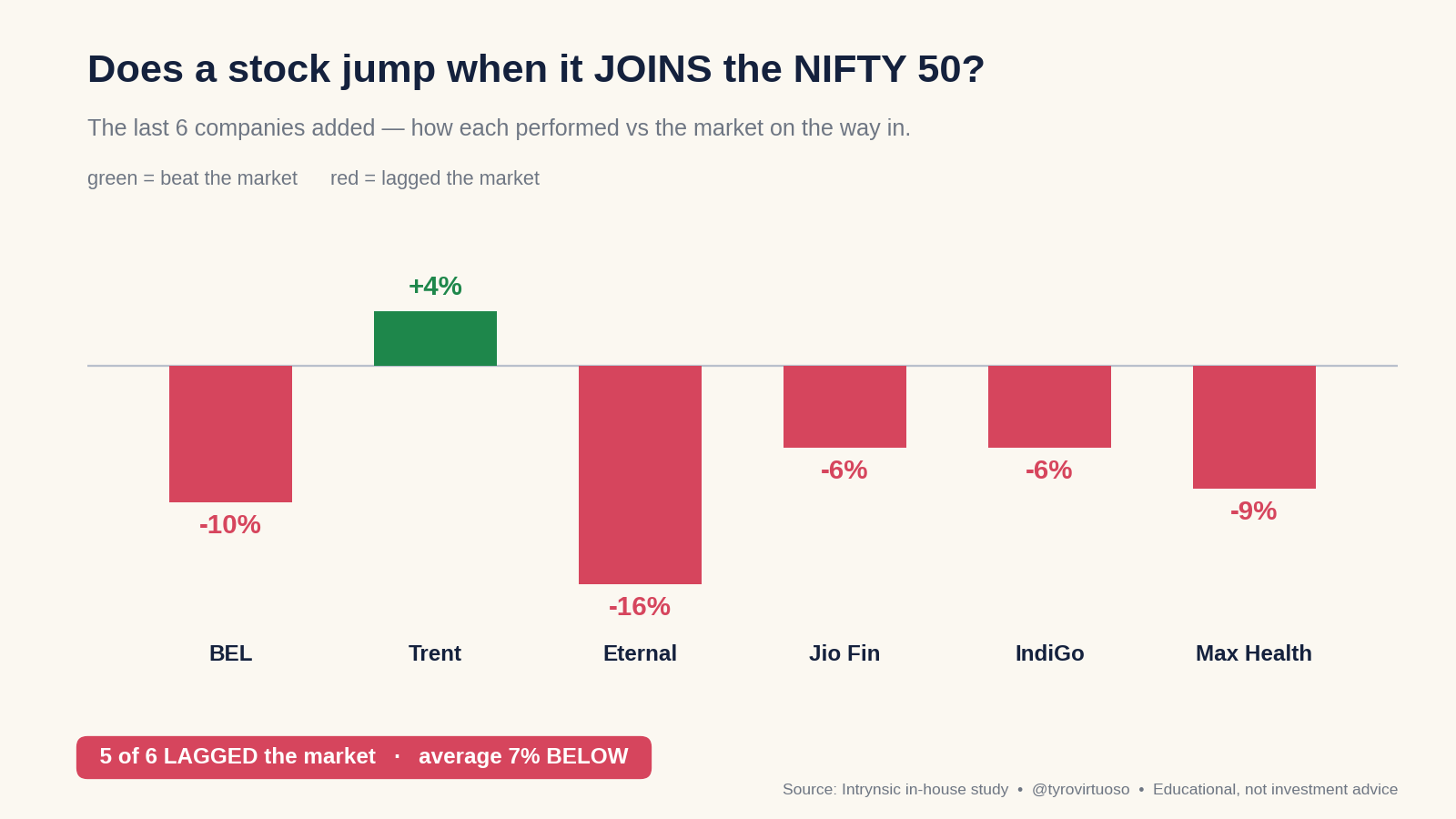
The "guaranteed jump" mostly did not happen. If anything, these stocks tended to underperform into their big day.
The twist: the recovery comes after, not before
Now look at the month after each stock actually joined. On average, they beat the market by about 4% - five of the six were positive. The strength showed up after the event, not before it.
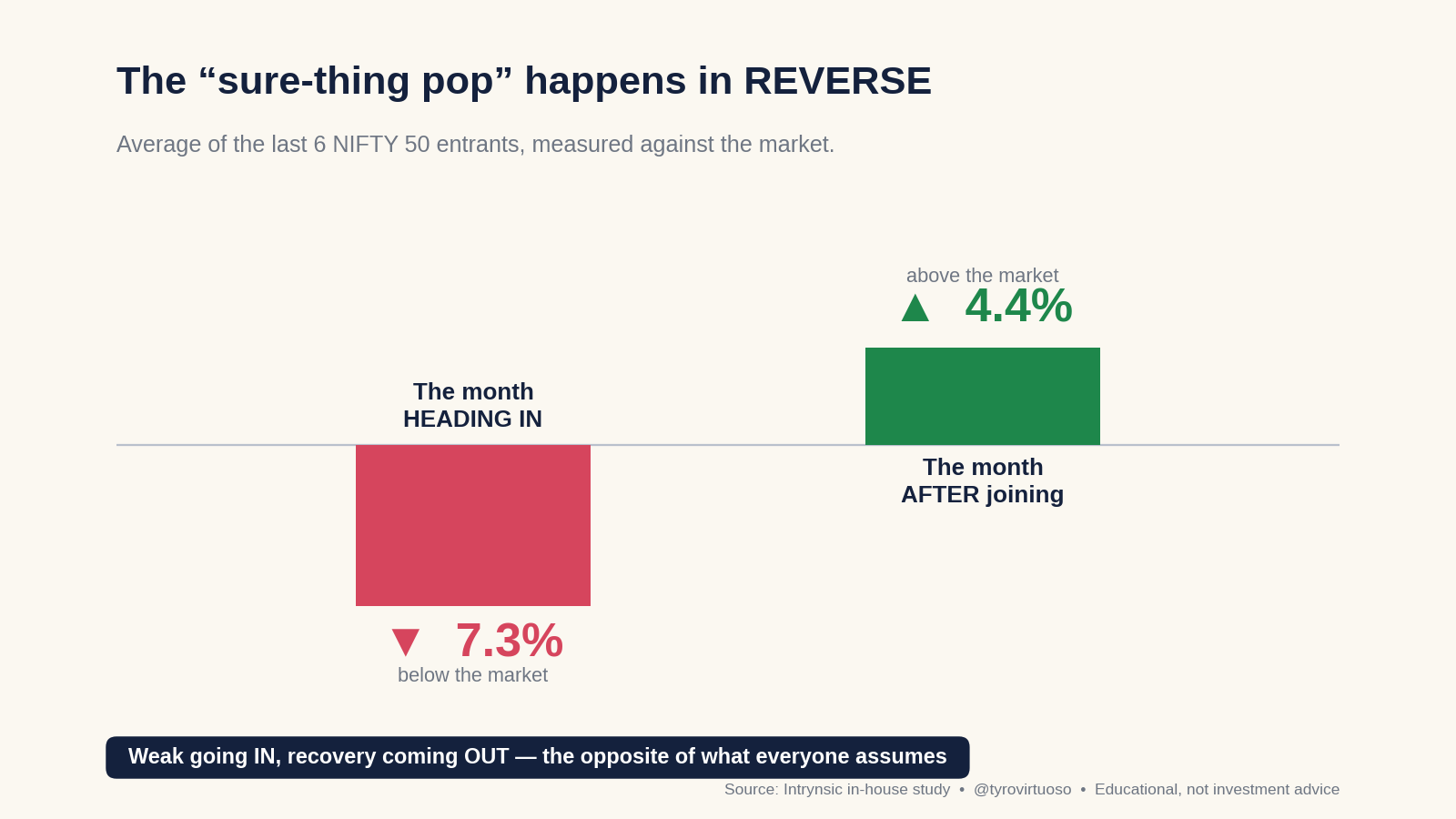
So the real pattern is the mirror image of the popular belief: weak going in, better coming out. Classic buy-the-rumour, sell-the-news - the anticipated buying is front-run out of existence before the date, and the stock tends to find its feet only once the event is behind it.
The real lesson
Being added to an index is a label change, not a fundamentals event. The business is exactly the same the day before and the day after it joins; the only thing that changes is which basket reports it. The forced buying is real, but it is small relative to a liquid stock's free float and fully telegraphed. Don't confuse a new address with a higher value.
So what about BSE?
BSE is the same setup: announced August 10, joining September 30, 2026, in place of Wipro - and it has already run up a great deal into the event. Betting on an entry-day pop means betting against what usually happens; across the last six inclusions, the base rate points the other way.
None of this is a prediction about BSE specifically - individual stocks move on their own stories, and six events is a small sample. It is a base-rate reality check on a very popular trade.
Educational only - not investment advice. Do your own research, and consult a SEBI-registered adviser before acting.
Follow along: @tyrovirtuoso on X