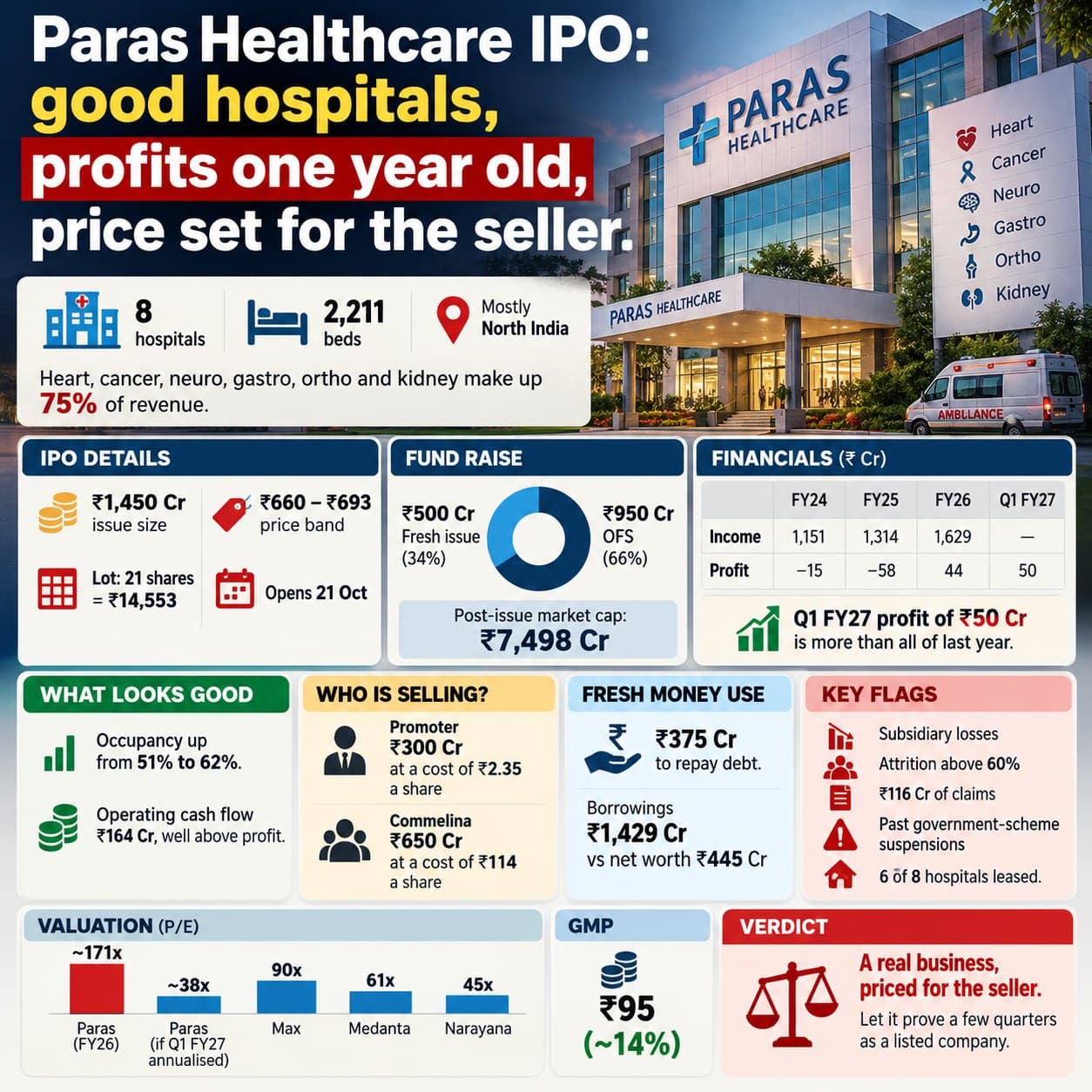
Paras Healthcare runs good hospitals that are getting better. The problem is the timing and the price. The first full year of profit came in FY26, and the IPO followed straight after.
The issue
Paras Healthcare opens on Wednesday, 21 October 2026 and closes on Friday, 23 October, at a price band of ₹660 to ₹693. The lot is 21 shares, ₹14,553 at the top of the band. Listing is expected on 28 October on NSE and BSE.
The issue is ₹1,450 crore: ₹500 crore fresh (34%) and ₹950 crore offer for sale (66%). An offer for sale, or OFS, is existing shareholders selling their shares; that money goes to them, not to the company. Post-issue market cap at ₹693 is ₹7,498 crore. Only 10% of the issue is reserved for retail investors; 75% goes to institutions and 15% to non-institutional investors. JM Financial, BofA Securities and Nuvama are the lead managers.
What the company does
Paras runs 8 hospitals with 2,211 beds in Gurugram, Panchkula, Patna, Darbhanga, Kanpur, Udaipur, Ranchi and Srinagar. About two-thirds of revenue comes from North India. It focuses on six high-value specialties: heart, cancer, neuro, gastro, ortho and kidney, which together make up about 75% of revenue. Two new hospitals, in Gurugram (300 beds) and Ludhiana (500 beds), are planned to take it to 3,011 beds by March 2028.
Well cooked or rushed?
Half cooked. The business is not new. The first hospital opened in Gurugram in 2006, and revenue has grown every year. Profit is new. The company lost ₹15 crore in FY24 and ₹58 crore in FY25, made ₹44 crore in FY26, and then filed for the IPO. The June 2026 quarter alone made ₹50 crore, more than all of FY26.
The improvement is real, not an accounting trick. Bed occupancy rose from 51% to 62%, and with more beds filled, EBITDA (profit before interest, tax and depreciation) more than doubled.
The numbers
| ₹ crore | FY24 | FY25 | FY26 | Q1 FY27 |
|---|---|---|---|---|
| Total income | 1,151 | 1,314 | 1,629 | 479 |
| EBITDA | 154 | 156 | 336 | 113 |
| PAT | -15 | -58 | 44 | 50 |
| Operating cash flow | 92 | 86 | 164 | |
| Borrowings | 924 | 1,232 | 1,394 | 1,429 |
| Bed occupancy | 52% | 51% | 62% |
Operating cash flow, the cash actually collected from running the hospitals, was ₹164 crore in FY26, well above profit. That is the best part of this IPO. The weak part is the balance sheet: borrowings of ₹1,429 crore against a net worth of ₹445 crore, about 3.2 times.
Who sells, and at what cost
- Promoter Dr. Dharminder Kumar Nagar sells ₹300 crore. His average cost is ₹2.35 a share, against an IPO price of ₹693.
- Commelina Ltd, an early investor, sells ₹650 crore. Its average cost is ₹114 a share, about 6 times its money.
Where the fresh money goes
- ₹375 crore repays debt: about ₹321 crore at the company and ₹54 crore at the subsidiary that runs the Srinagar hospital. This helps, but it cuts only about a quarter of the debt.
- The rest goes to general corporate purposes.
- None of the IPO money is earmarked for the two new hospitals, so more borrowing is likely as they get built.
Valuation vs peers
| P/E | |
|---|---|
| Paras Healthcare (FY26 profit) | ~171x |
| Paras Healthcare (Q1 FY27 profit x 4) | ~38x |
| Max Healthcare | 90x |
| Medanta (Global Health) | 61x |
| Narayana Hrudayalaya | 45x |
On FY26 profit, Paras is far more expensive than every large listed hospital chain. It looks cheap at about 38x only if one good quarter is repeated for a full year. That is a big ask for a company whose profits are one year old. Max and Apollo are the leaders in the industry, each worth over ₹1 lakh crore. Paras is a regional, mid-sized chain.
The market itself is large and growing. India's private hospital sector was about $122 billion in 2025 and is expected to reach about $202 billion by 2030, according to Brickwork Ratings.
Flags from the offer document
- Subsidiary losses: ₹52 crore in FY26, ₹82 crore in FY25 and ₹87 crore in FY24.
- Attrition above 60% every year. In a hospital, staff turnover of that level matters.
- About ₹116 crore of claims pending against the company, plus proceedings against the promoter and directors.
- Past suspensions from government health scheme empanelments.
- 6 of 8 hospitals run on leased or revenue-share sites.
- Project delays at Srinagar, Kanpur and Ranchi. Srinagar's occupancy is only 36%.
SWOT
- Strengths: high-value specialties, Tier 2 city presence, rising occupancy, strong cash flow.
- Weaknesses: one year of profit, high debt, leased hospitals, high attrition.
- Opportunities: 800 new beds, newer hospitals still filling up, a fast-growing hospital market.
- Threats: new hospitals take years to break even, price controls on treatments, large chains moving into Tier 2 cities.
Demand
The grey market premium (GMP) is about ₹95, around 14% over the top of the band. The issue has not opened yet and the anchor book is still to come. GMP is a signal of sentiment, not a verdict on the business. Building demand is the lead managers' job.
Fun fact
Healthcare has been one of the few bright spots this year. On the Intrynsic Sector Hub, the healthcare sector (tracked by the Nifty Pharma index) is up about 13% year to date, while the Nifty 50 is down about 12%. That tailwind helps explain the timing of this IPO.
Verdict
A real business, but clearly priced for the seller. I would avoid it at this price and look to buy at lower levels after a few more profitable quarters as a listed company.
Educational purposes only, not investment advice. DYOR.
Sources: Paras Healthcare Limited draft red herring prospectus and abridged prospectus (SEBI, June 2026); Chittorgarh IPO page; Chanakya Nipothi IPO review; IPOji, 16 October 2026; Screener hospital peer data; Brickwork Ratings via IANS (November 2025); Intrynsic Sector Hub, 16 October 2026.
Follow along: @tyrovirtuoso on X