Paytm Block Deal: Naam Resilient ka, Paisa Antfin ka.
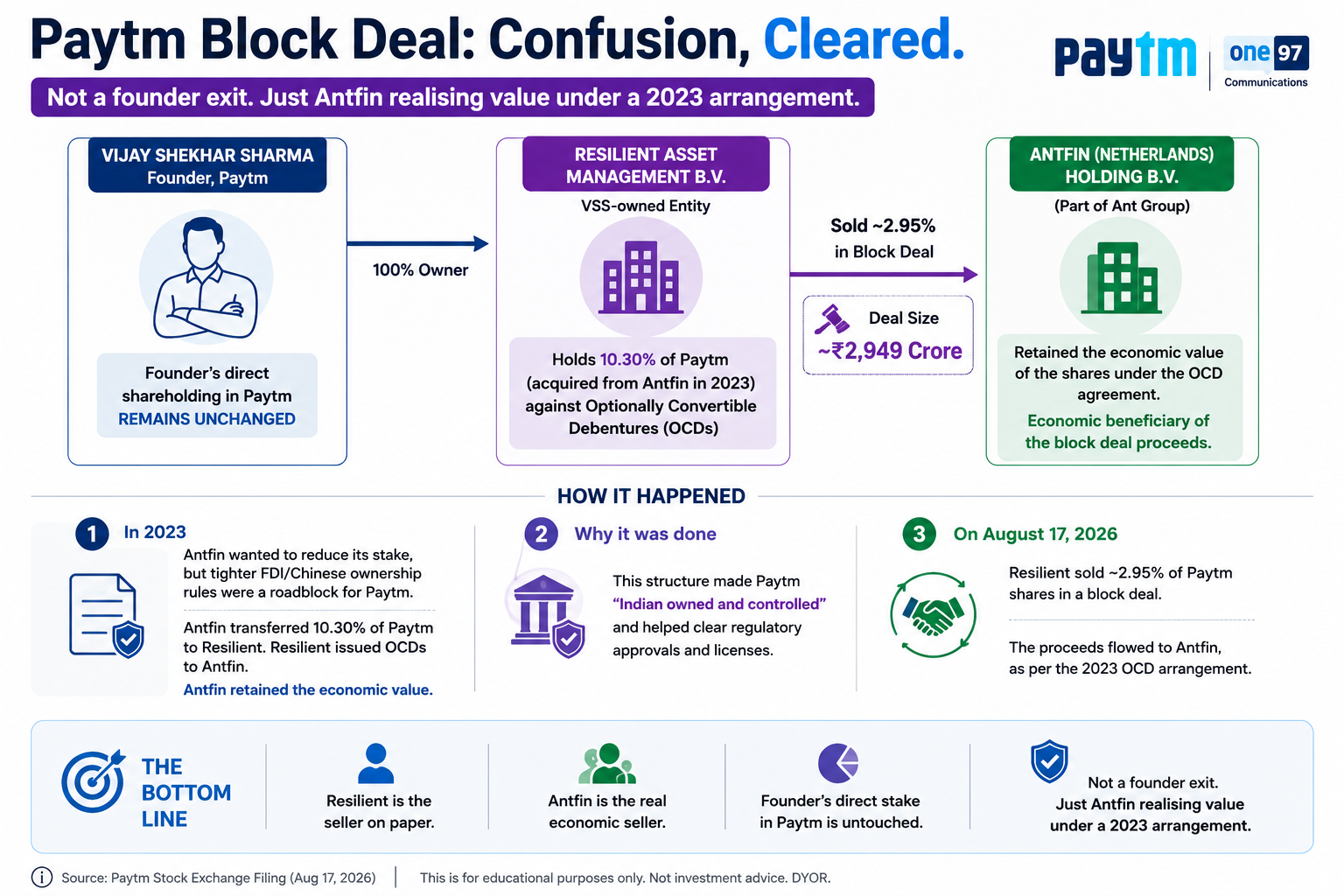
On Aug 18, 2026, a large block deal hit Paytm's parent, One 97 Communications: about 2.95% of the company changed hands for roughly Rs 2,949 crore. The seller on paper was Resilient Asset Management B.V., an entity owned by Paytm founder Vijay Shekhar Sharma.
Naturally, the internet reached for the obvious headline: the founder is cashing out. Except he isn't. Here is the real story, told simply.
Think of it like holding a friend's suitcase
Imagine a friend asks you to hold their suitcase for a while. Your name is on the tag, you carry it, you decide when to hand it over. But everyone knows the cash inside the suitcase was always your friend's. When the suitcase is finally sold, the money goes back to your friend, not to you.
That is essentially what Resilient did for Antfin.
Who is who
Antfin (Antfin Netherlands Holding B.V.) is one of Paytm's earliest big investors, part of China's Ant Group (the Alibaba family). For years it held a large stake in Paytm.
Resilient is an entity owned by Vijay Shekhar Sharma, the founder and CEO.
Why the suitcase changed hands in 2023
After the 2020 border tensions, India tightened its rules on foreign direct investment coming from neighbouring countries, China included. Any large Chinese ownership now needed extra government scrutiny.
That became a real problem for Paytm. Antfin's big holding meant Paytm was not seen as an Indian owned and controlled company, and that status blocks or slows key approvals and licences (payments, lending partnerships, and so on).
So in 2023 a clever structure was used. Antfin moved about 10.3% of Paytm to Resilient. On paper, an Indian founder-owned entity now held the shares, which helped Paytm qualify as Indian owned and controlled and cleared the regulatory logjam.
But there was a crucial condition. The economic interest stayed with Antfin. The shares were parked with Resilient through an instrument (optionally convertible debentures) that guaranteed Antfin would receive the cash whenever the shares were eventually sold. Voting and legal custody with the Indian entity, money still Antfin's. The suitcase, held by you; the cash inside, still your friend's.
What actually happened yesterday
Resilient sold the stake in the block deal. The cash did not stop with Resilient or with Vijay Shekhar Sharma. It flowed through Resilient to Antfin. This was Antfin finally collecting the money it was always owed under the 2023 arrangement.
So who is the real seller? On paper, Resilient. In economic reality, Antfin.
Does the founder pocket anything here?
No. His direct, personal shareholding in Paytm is untouched by this deal. He is not selling his own stake, and he is not taking these proceeds. Resilient was the executor of someone else's exit, not a founder heading for the door.
My read
This is one of those cases where the paperwork and the economics point at two different people, and the crowd naturally reads the paperwork.
Strip away the noise and it is simple: a 2023 workaround, built to satisfy India's FDI rules, has reached its natural end. Antfin is walking down its remaining economic interest in Paytm. Resilient was just the Indian name on the tag.
Not a founder exit. Not a loss of faith in Paytm by its founder. Just the last chapter of an arrangement most people never knew existed.
When a deal confuses the market, it usually pays to ask one question: who actually gets the cash? Follow the money, not the name on the trade.
Educational only, not investment advice. DYOR.
Read the official disclosure (PDF) - One 97 Communications' Regulation 30 filing to BSE and NSE.
Sources: One 97 Communications stock-exchange disclosure under SEBI LODR Regulation 30 (Aug 2026); Paytm's Aug 7, 2023 disclosure of the Antfin-Resilient optionally convertible debenture arrangement; India's Press Note 3 (2020) FDI rules for bordering countries.
Follow along: @tyrovirtuoso on X