Order shipped, profits still in transit - Shiprocket IPO ka retail funda.
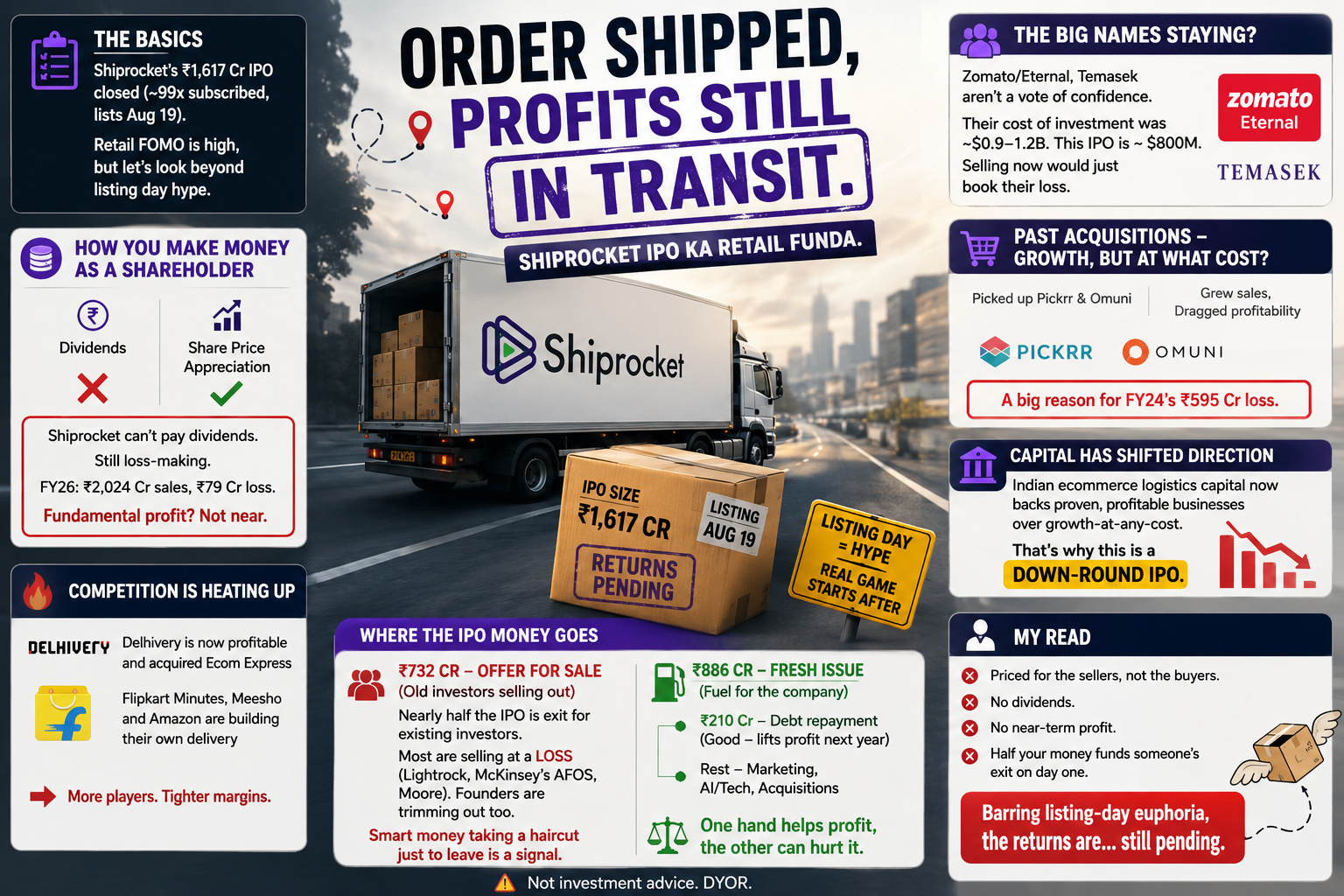
Shiprocket's ₹1,617 crore IPO has just closed - subscribed about 99 times, listing on August 19. Here is my honest read, purely from a retail investor's seat: this looks priced for the people selling, not the people buying.
Not investment advice - just how I see it.
First, the only two ways you actually make money
Set listing day aside. That is a coin toss where hype beats logic, and it tells you nothing about the business. Once the noise clears, a shareholder earns in exactly two ways: dividends, or the share price rising on fundamentals.
Shiprocket can do neither soon. It still loses money - FY26 revenue was ₹2,024 crore but it posted a ₹79 crore net loss (and a ₹74 crore loss the year before). A loss-making company cannot pay dividends, and it will not re-rate higher on fundamentals until profits actually arrive. So the only honest way to judge this IPO is to follow the money.
Where the ₹1,617 crore goes
Nearly half of it never touches the company. The issue splits into a fresh issue of ₹886 crore (new money the company keeps) and an offer for sale of ₹732 crore (existing investors cashing out). That second half - about 45% of the whole IPO - simply moves from your pocket to theirs on day one.
The sellers, and the ones "staying"
Look at who is selling, and how. Several late-stage backers - Lightrock, McKinsey's AFOS vehicle, and Moore Strategic Ventures - are offloading their shares below what they paid. The founders are trimming their stakes too. When patient, professional money is willing to take a haircut just to get out, that is not a rounding error. It is a message.
And do not read too much into the big names who are not selling. Zomato (now Eternal) and Temasek are holding, but not out of conviction - they are simply underwater. They backed Shiprocket at roughly a $0.9-1.2 billion valuation; this IPO values it at about $800 million. Selling now would just lock in their loss, so holding is the least-bad option, not a bet on the upside.
The fresh money: one clean win, one familiar risk
The ₹886 crore of genuinely new capital is the only part that builds the company. Here is where it goes:
| Where the fresh ₹886 Cr goes | Amount |
|---|---|
| Repay borrowings | ~₹210 Cr |
| Marketing & customer acquisition | ~₹206 Cr |
| Technology, AI & infrastructure | ~₹160 Cr |
| Acquisitions + general corporate | Balance |
The ₹210 crore of debt repayment is the one clean positive - it makes Shiprocket nearly debt-free, cuts interest cost, and should lift the margin next year. The marketing and tech spend is the usual "invest now, profit someday" story.
The part that gives me pause is the acquisitions. Its last big buys - Pickrr and Omuni - did grow revenue faster than the core business, but they were a heavy drag on profitability and a big reason FY24's loss ballooned to ₹595 crore. So debt repayment lifts profit with one hand, while fresh M&A can pull it back down with the other.
A profitable core, wrapped around a cash-burning shell
To be fair, there is a real business here. Shiprocket's core - domestic shipping aggregation, about 73% of revenue - is genuinely profitable. The problem is the emerging businesses (cross-border, quick-commerce, lending, fulfilment), roughly 27% of revenue, which are still burning cash and dragging the whole company into the red. Until those either turn or are reined in, group-level profit stays out of reach.
The competition is closing in
This is not a quiet corner of the market either. Delhivery just turned profitable (FY25) and swallowed Ecom Express, creating a far bigger, listed rival. Meanwhile the giants are building their own logistics - Flipkart Minutes, Meesho's Valmo, and Amazon - which lets them bypass third-party aggregators like Shiprocket entirely. More players chasing the same parcels means margin compression, not expansion.
The mood of the money has changed
Zoom out and the signal is everywhere. Capital in Indian ecommerce-logistics has swung from "growth at any cost" to consolidation and proven unit economics - funding into the space has actually fallen sharply. That shift is exactly why Ecom Express's own IPO collapsed, why several Shiprocket backers are exiting below cost, and why this deal priced about 30% below its 2024 private valuation. In plain terms: this is a down-round IPO.
My take
Shiprocket is a real, scaling business with a genuinely profitable core - but this IPO is structured for the sellers, not the buyers. You cannot earn a dividend, fundamental share-price gains need profits that simply are not near, and roughly half your money funds someone else's exit on the very first day. The one clear win is the debt repayment; almost everything else is a "someday."
So my honest view: barring listing-day euphoria, the returns here are - fittingly for a shipping company - still pending.
Educational only - not investment advice. Do your own research, and consult a SEBI-registered adviser before acting.
The original thread: my post on X Follow along: @tyrovirtuoso on X