
Most re-rating stories work the same way: the price runs first, and earnings scramble to justify it. Syncom Formulations (NSE: SYNCOMF) is the rare case where it's the other way around - the earnings sprinted, and the price only jogged to keep up. It's a ~₹1,370 crore pharma company quietly remaking itself, and almost nobody is watching.
Not investment advice - just what caught my eye when I ran the numbers.
A four-year transformation (FY2022 to FY2026)
The operating story is genuinely good:
- Revenue: ₹216 crore to ₹489 crore
- PAT: ₹20 crore to ₹76 crore - roughly a 40% CAGR
- EBITDA margin: ~15% to ~22%
- Debt: ₹83 crore to ₹1 crore - effectively net-cash now, with ₹113 crore on the books
So over four years the company more than doubled revenue, nearly quadrupled profit, expanded margins, and paid down almost all its debt. That isn't a cyclical bounce; it's a structural clean-up.
The gap that caught my eye
Here's the mismatch. Earnings compounded at roughly 37% a year. The stock compounded at just 15.7% a year (₹8.10 to ₹14.53). Earnings sprinted; the price jogged.
For a name that's on everyone's radar, it's usually the reverse - the price races ahead of the fundamentals. When the fundamentals are ahead of the price, it usually means the market simply hasn't noticed yet.
Valuation vs peers
Against a peer set (Amrutanjan, NGL Fine Chem, KPL, Aarey Drugs), Syncom looks cheap on every lens:
- P/E 17.9x vs a peer median of 47.6x - about 40% below the peer floor
- PEG 0.48x - growth is being handed to you at a discount
- EV/EBITDA 11.6x
- FCF yield 3.4%, on FY2026 free cash flow of ₹46 crore (it was negative in FY2023-24)
A sub-20x P/E on ~40% earnings growth, with a PEG under 0.5, is the combination value investors say they hunt for and rarely actually find.
Why nobody's watching (yet)
The ownership table tells the story: promoters 50.57%, FIIs 0.21%, DIIs 0%. Institutions have basically not shown up. That's exactly why the valuation gap exists - and it's a double-edged sword.
The risks, up front
I'd rather flag these than bury them:
- Thin institutional coverage means low liquidity, and a ~49% public float means the stock can be volatile in both directions.
- Leadership exits. There have been recent founder/leadership departures. From what I've read they're tied to health and succession rather than any governance problem - but any founder exit is worth watching.
- The accounts look clean. On a first read of the annual report and auditor's opinion there's nothing alarming - a notable contrast to some other small-caps.
The technical picture
After months of correction and consolidation below its 200-day EMA, the stock appears to be setting up for a breakout over key resistance. A reclaim of the 200-DEMA on rising volume would be the tell that the trend is actually turning.
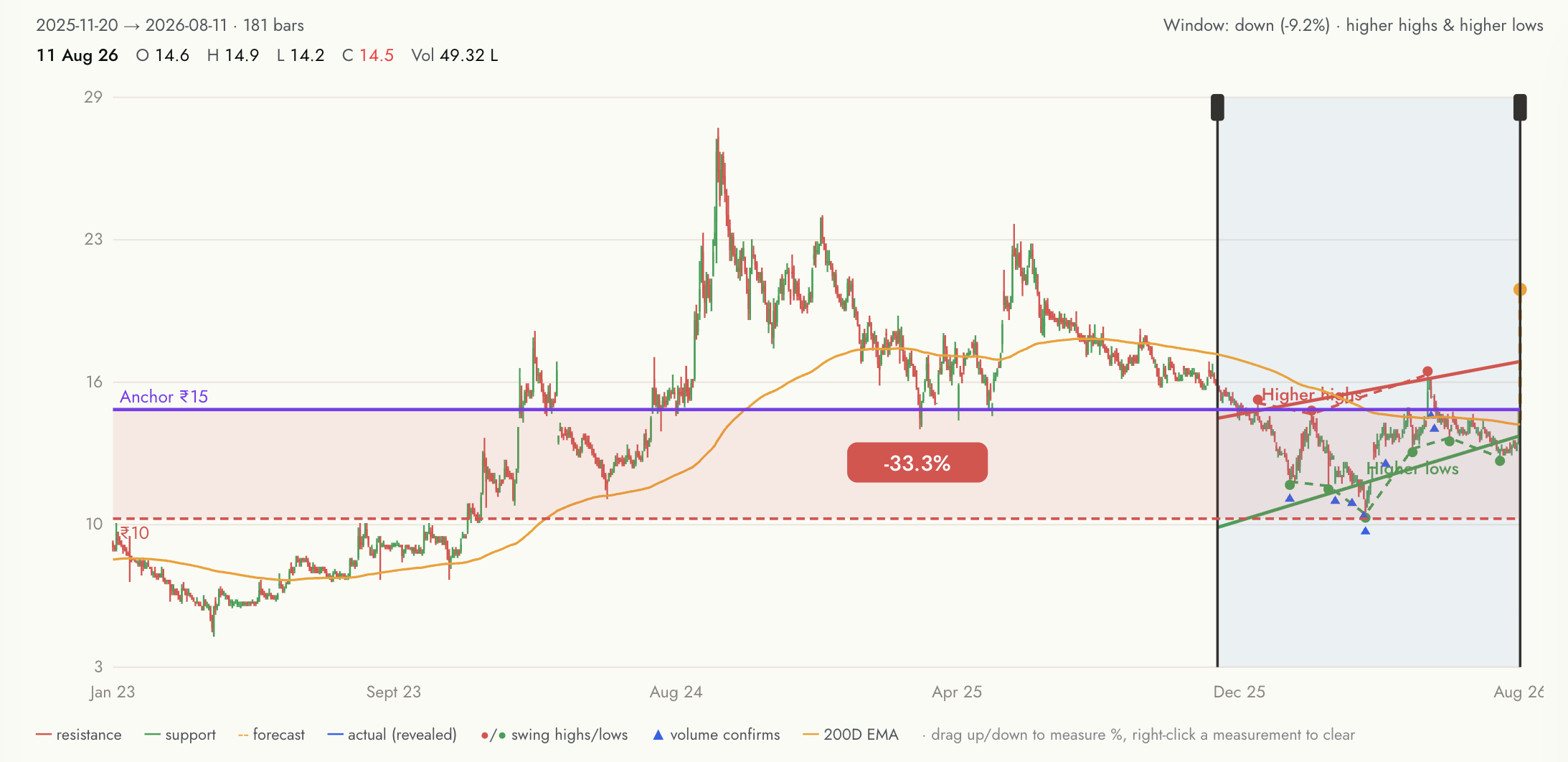
Syncom's technical view on Intrynsic: months of consolidation below the 200-day EMA (orange line), with a higher-highs / higher-lows structure now forming as price presses toward resistance.
My take
Strip it down and Syncom is a rare three-way combination: real earnings growth, a clean (net-cash) balance sheet, and a steep discount to peers. The one variable that decides whether it re-rates is simple to state and hard to predict - does revenue growth continue? If it does, the peer discount gets hard to justify and the market eventually notices. If growth stalls, the discount is the market being right. Either way, this is a business worth understanding rather than ignoring.
Educational only - not investment advice. Do your own research, and consult a SEBI-registered adviser before acting.
Full data snapshot: Syncom Formulations on Intrynsic The original thread: my post on X On the leadership change: Founder Kedarmal Shankarlal Bankda resigns (ScanX) Follow along: @tyrovirtuoso on X