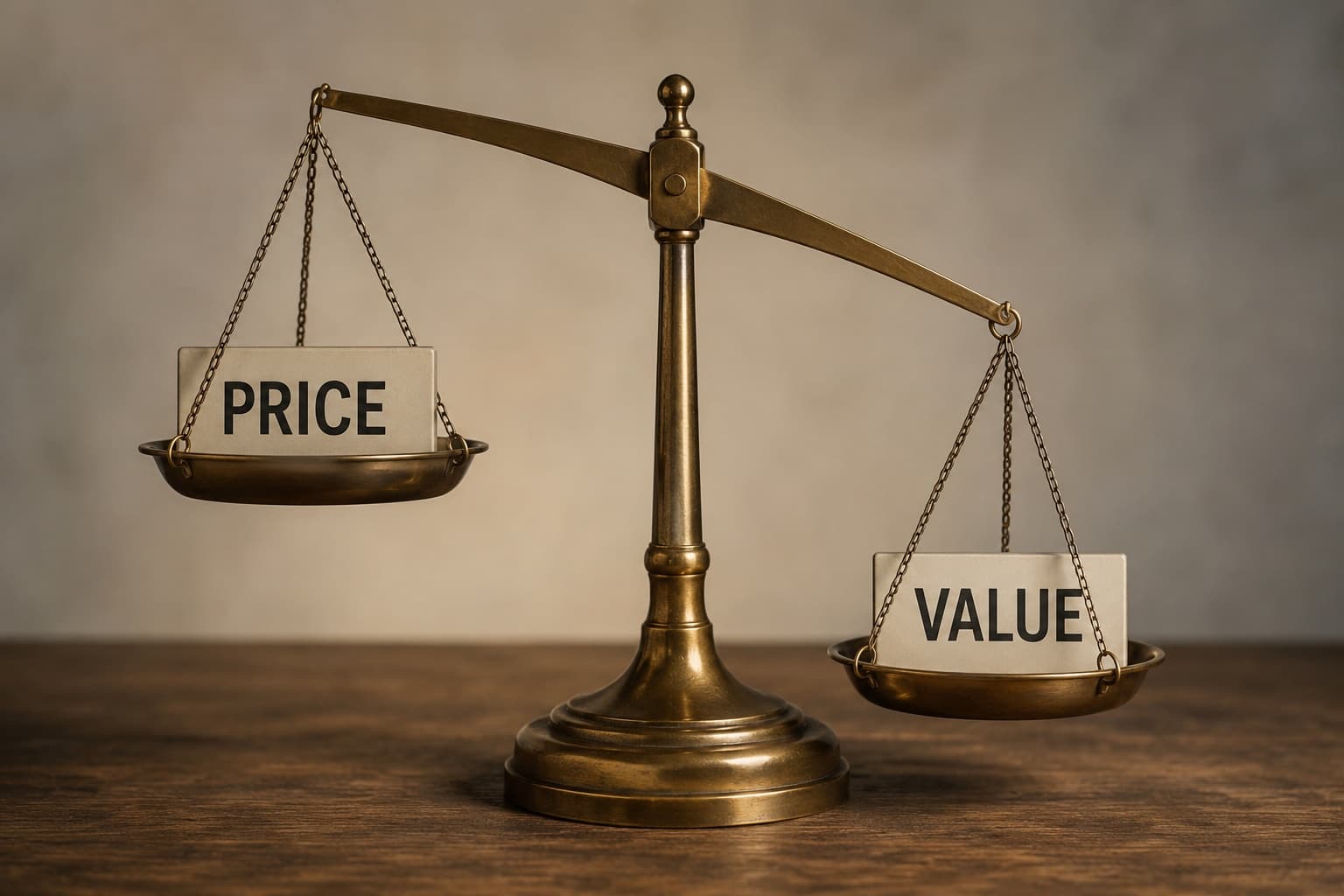
Ask any investor why they bought a stock, and you'll rarely struggle to get an answer.
Some will say the P/E ratio looked attractive. Others will point to strong quarterly results, a recommendation from a friend, a management interview, or a chart that looked ready for a breakout. Some will simply say they believe the company has a bright future. Others will admit they bought because everyone around them seemed to be buying.
The reasons are usually delivered with confidence.
Now ask a different question.
"What do you think this business is worth?"
The confidence often disappears.
Not because people suddenly become less intelligent, and not because they stop caring. It's because very few investors have ever been taught that this is where investing is supposed to begin.
That, in my opinion, is one of the biggest mistakes retail investors make. Not that they fail to value businesses - but that they never realise they should.
And the surprising part is that this isn't entirely their fault.
To see what I mean, forget the stock market for a moment.
Imagine someone offered to sell you a neighbourhood restaurant. The owner wants ₹50 lakh.
Before deciding whether that's expensive or cheap, you would naturally begin asking questions about the business. How much money does it make? Are customers coming back? Is the location good? Who are the competitors? Can it keep growing? Does it have a reputation people are willing to pay for?
Only after understanding the business would you decide whether ₹50 lakh is a fair price.
Now imagine the same restaurant is listed on the stock exchange. Something interesting happens.
Instead of asking how the business makes money, we ask where the stock traded yesterday. Instead of discussing whether it can generate more cash over the next ten years, we discuss whether it has corrected enough from its recent highs. Instead of asking whether the business has become more valuable, we ask whether the market will take it higher next week.
The business hasn't changed. Only our questions have.
And once you notice this, you start hearing it everywhere. Listen to the conversations investors have every day:
"This stock has doubled."
"It's down 30%."
"It's trading near its all-time high."
"Foreign investors are buying."
"The valuation looks expensive."
None of these statements are wrong. They all describe something that has happened. But they all have one thing in common: they describe what the market is doing. Almost none of them describe what the business is worth.
Over time, we begin to mistake those two things for the same. They aren't.
The confusion hides inside even our most common phrases. Take the sentence investors use more than almost any other: "This stock looks expensive."
Expensive compared to what? Compared to where it traded last year? Compared to another company? Compared to its P/E ratio? Compared to an analyst's target price? Or compared to what the underlying business is actually worth?
Those are completely different comparisons, yet we use the same word - expensive - as though they all mean the same thing.
A stock can double in price and still be undervalued if the business has become significantly stronger. Another can fall by half and still be expensive if the economics of the business have deteriorated even faster.
A stock price, by itself, has no opinion attached to it. ₹500 isn't cheap. ₹500 isn't expensive. It is simply ₹500. The moment you estimate the business is worth ₹800, the number begins to mean something.
Until then, it is just a number.
Which raises the obvious question: if the price alone tells us so little, why do so many intelligent investors begin there?
The easy answer is that valuation is difficult. I don't think that's the real reason. The real reason is that almost everything surrounding the stock market quietly teaches us to think this way.
Think back to your own journey as an investor. You probably didn't begin with an annual report. Like most people, you downloaded a brokerage app, opened a financial website, watched videos, followed market news, and slowly learned the language of investing from the information that was easiest to find.
Without realising it, you entered a world where prices dominate almost every conversation. Open a brokerage app and the largest numbers on the screen are prices. Turn on business television and the discussion revolves around today's gainers, tomorrow's expectations, and the next market trigger. Scroll through social media and you'll find predictions, targets, and endless debates about where stocks are headed next.
None of this exists because the industry is trying to mislead people. It exists because prices are easy to observe, and value isn't.
A price is objective - every investor looking at the same stock at the same moment sees exactly the same number. Value requires understanding the business, making assumptions about its future, and accepting that reasonable people can disagree. One can be displayed instantly on a screen. The other has to be developed through thought.
Human beings naturally gravitate towards information that is immediate, visible, and easy to consume. And over time, something subtle happens: we begin to mistake the information that is most visible for the information that is most important.
That isn't just an investing problem. It's a human one.
The stock market simply amplifies it - because prices change constantly, while businesses do not.
A share price may move twenty times before lunch. The business probably hasn't. Its factories didn't become more productive during those thirty minutes. Its customers didn't become twice as loyal before the market closed. Its competitive advantage didn't disappear because of a morning headline.
Yet our attention follows the thing that moves - not the thing that creates value.
Perhaps that's why so many investors slowly begin believing that investing is about predicting prices rather than understanding businesses. And once that happens, the questions change:
"Will the stock go higher?"
"Is this the right time to enter?"
"What's the target price?"
They're perfectly reasonable questions. But notice something: every one of them begins with the market. Very few begin with the business.
So perhaps the interesting question isn't why so few investors learn valuation. It's this: how could they have learned to ask a different question, when almost everything around them encourages them to ask this one?
So let's ask the different question now. If investing should begin with the business, it's worth being clear about what a business actually is.
A business is not a ticker symbol. It is not a chart, and it is not the green and red numbers that flash across a brokerage screen.
A business is an economic engine. It takes capital, people, technology, ideas, relationships, brands, and factories, and combines them to create products or services that customers willingly pay for. If it does this well, it generates cash. If it can keep doing it year after year while strengthening its competitive position, it becomes more valuable.
Everything we analyse as investors - revenue, margins, cash flows, debt, competitive advantages, management quality - is simply evidence. Each piece helps us answer one much larger question:
How much economic value can this business create for its owners in the future?
And if you hold even a single share, that word - owners - includes you.
That is what valuation is trying to estimate. Not tomorrow's share price. Not next quarter's earnings surprise. The value of the business itself.
How do you actually estimate that? What is valuation really measuring, and why do experienced investors insist it's not primarily a mathematical exercise? That's a question worth its own article - and it's the one I take up in the next essay, What Valuation Is Actually Measuring.
Until then, here's a simple exercise: pick one company you own, and try answering just one question about it - how does this business make money? You may be surprised how much that single question changes what you notice.
You can also explore the estimated fair value of over 5,000 Indian companies on Intrynsic - free - and start comparing price with value yourself.
This is the first of a three-part series. Continue with Part 2: What Valuation Is Actually Measuring and Part 3: How Valuation Changes Your Decisions.
Educational Disclaimer: This article is intended solely for educational purposes and should not be construed as investment advice or a recommendation to buy, sell, or hold any security. Intrynsic is not a SEBI-registered Research Analyst or Investment Adviser. Any estimate of fair value depends on assumptions that may change over time and should be treated as an analytical framework rather than a prediction.